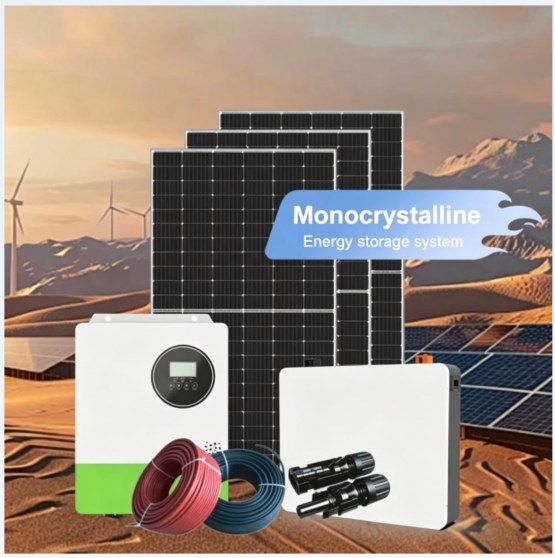
A home energy storage system lets you store electricity from solar panels or the grid, then use it when you actually need it — at night, during peak tariff hours, or when the grid goes down. For homeowners in markets with rising electricity prices, time-of-use tariffs, or unreliable grids, it has moved from a luxury item to a practical investment.
But choosing the right system is not simply a matter of buying the biggest battery you can afford. Capacity, power output, battery chemistry, inverter compatibility, and installation environment all have to match your household. This guide walks you through every decision in order, so you can specify a system that performs reliably for 10 years or more.
What Exactly Is a Home Energy Storage System?
A complete home energy storage system is made of four functional parts:
- Battery modules — store energy chemically. The installed capacity is measured in kWh.
- Battery management system (BMS) — protects cells from over-charge, over-discharge, over-temperature, and keeps cells balanced.
- Inverter / power conversion system — converts DC battery power into AC power for your home, and charges the battery from solar or the grid.
- Energy management system (EMS) — decides when to charge, when to discharge, and how to prioritise solar, battery, and grid.
In practice you will be offered three packaging formats: an all-in-one unit (inverter and battery in one enclosure), a stackable battery system that grows module by module, and a rack or cabinet system for larger homes and small commercial sites. Choosing the format is really choosing how much you expect your needs to change over time.
Step 1: Start With Your Daily Electricity Consumption
Everything begins with a number: how many kWh does your household consume per day? Pull 12 months of electricity bills and divide the annual consumption by 365. If you do not have 12 months of data, use the summer and winter peak months as your reference.
Typical daily consumption patterns look like this:
| Household profile | Daily consumption | Recommended usable storage | Typical system format |
|---|---|---|---|
| Apartment, 1–2 people, no EV | 5–10 kWh | 3–5 kWh | All-in-one |
| Small house, 3–4 people, no EV | 10–20 kWh | 5–10 kWh | All-in-one or stackable |
| Large house, 4–6 people, heat pump | 20–35 kWh | 10–20 kWh | Stackable |
| House with EV charging | 30–50 kWh | 20–40 kWh | Stackable or cabinet |
The single most common mistake is sizing the battery against the whole daily consumption. In most homes, a well-sized system covers the evening and night load — roughly 50 to 70 percent of daily consumption — while solar or cheap off-peak grid power covers the rest in real time. Oversizing the battery increases cost without increasing savings.
Step 2: Check Power Rating, Not Just Capacity
Capacity (kWh) is how much energy the battery holds. Power (kW) is how fast it can deliver that energy. A 10 kWh battery with a 5 kW continuous output cannot run a 7 kW appliance cluster, no matter how much energy is left in the tank.
Add up the appliances you want to run simultaneously during a backup event — refrigerator, lights, internet, a few sockets, and ideally a water pump or air conditioner. Then add a safety margin of 20 to 30 percent. If you plan whole-home backup, verify the peak power rating of the inverter as well, because motor loads such as pumps and compressors draw several times their rated power for a fraction of a second at start-up.
Step 3: Understand Battery Chemistry Before You Compare Prices
The two chemistries you will see offered for residential storage are LiFePO4 (lithium iron phosphate) and NMC (nickel manganese cobalt).
| Criteria | LiFePO4 | NMC |
|---|---|---|
| Cycle life | Typically 6,000+ cycles | Typically 2,000–4,000 cycles |
| Thermal stability | Very high — high thermal runaway threshold | Lower — requires stricter thermal management |
| Depth of discharge | Usually 90–95% usable | Usually 80–90% usable |
| Energy density | Lower, larger and heavier | Higher, more compact |
| Cost per kWh over lifetime | Generally lower | Generally higher |
For a stationary installation on a wall or in a garage, weight and volume are rarely the limiting factors, while safety and cycle life matter a great deal. LiFePO4 modules are available from 12.8 V small-format packs up to 51.2 V stackable units, and most residential systems now use this chemistry for good reason.
Step 4: Match the System to Your Existing Inverter
There are three common scenarios, and they lead to very different product choices:
- New installation with solar. Use a hybrid inverter that manages solar, battery, grid, and backup in one device. This is the cleanest architecture, and it is the one we build our residential kits around.
- Existing string inverter, no backup need. Add an AC-coupled battery system. Cheaper to install, but it converts DC to AC and back, losing a few percent of efficiency.
- Existing hybrid inverter from another brand. Check the supported battery voltage range and communication protocol list before ordering batteries. Compatibility is a specification question, not a marketing claim — ask for the protocol list in writing.
Step 5: Decide Between All-in-One, Stackable, and Cabinet
| Format | Best for | Advantages | Watch out for |
|---|---|---|---|
| All-in-one | Apartments, small houses, limited wall space | Compact, plug-and-play, single warranty contact | Hard to expand later |
| Stackable | Families who expect their needs to grow | Add a module at a time, 3–60 kWh range, easy service | Needs floor or wall space and correct base anchoring |
| Rack / cabinet | Large homes, villas, small commercial sites | High capacity, integrated cooling and fire protection | Higher upfront cost, needs professional installation |
Step 6: Verify Efficiency, Depth of Discharge, and Real Capacity
Two figures determine how much of the nameplate capacity you can actually use:
- Round-trip efficiency — how much energy comes back out compared with what went in. Good systems reach 90 to 95 percent. Below 85 percent, the losses start to matter financially.
- Depth of discharge (DoD) — the percentage of capacity you can use without harming cycle life. A 10 kWh battery at 90 percent DoD gives 9 kWh of usable energy.
When comparing quotes, always compare usable kWh, not nameplate kWh. A 10 kWh NMC pack at 85 percent DoD offers less usable energy than a 10 kWh LiFePO4 pack at 94 percent DoD — and the LiFePO4 pack will last longer.
Step 7: Confirm Certifications and Warranty Terms
Certification is not paperwork — it is evidence that the product passed independent safety testing. For residential storage, look for:
- Cell and module level: UN38.3 for transport, IEC 62619 for industrial lithium safety, and MSDS documentation.
- System level: UL 9540 or the equivalent regional standard for energy storage systems, and CE marking for European markets.
- Grid connection: the local grid-code certification required by your utility if you want feed-in approval.
On warranty, read three numbers: the warranty period, the minimum retained capacity at the end of that period, and the annual cycle allowance. A “10-year warranty” that requires 8 years of qualifying data and limits cycles to 300 per year is worth less than a straightforward 10-year, 6,000-cycle commitment. Also check who fulfils the warranty locally — a warranty you cannot claim in your own country is a promise, not protection.
Step 8: Plan the Installation Location
Battery performance depends on temperature. Most lithium storage systems are happiest between 15 °C and 30 °C. If the unit must go in a garage, on an exterior wall, or in an unheated utility room, confirm the operating temperature range and IP rating:
- IP20–IP21 — indoor, dry, dust-controlled rooms only.
- IP65 — outdoor wall mounting, rain and dust resistant.
- Cabinet systems — usually IP54 or IP55 with active thermal management for larger installations.
Also allow clearance for airflow and service access, and check local fire-code requirements for separation distances from sleeping areas in some jurisdictions.
Common Mistakes to Avoid
- Buying on capacity alone. A big battery behind an undersized inverter cannot deliver the power your home needs.
- Ignoring the backup load list. Decide what must keep running before you choose the system, not after.
- Chasing the cheapest cells. Cell quality determines whether the system holds 80 percent capacity in year 8 or year 3.
- Forgetting expansion. If you may add an EV or a heat pump, choose a stackable architecture now.
- No monitoring. Without an app or portal showing charge, discharge, and cycle data, you cannot prove warranty claims or optimise tariffs.
Frequently Asked Questions
How many kWh of storage does a typical home need?
Most homes use a 5 to 15 kWh usable storage system. Start from daily consumption and size the battery to cover the evening and night period, which is normally 50 to 70 percent of daily use.
Is LiFePO4 better than NMC for home storage?
For stationary home storage, LiFePO4 is usually the better choice: higher cycle life, better thermal stability, and a higher usable depth of discharge. NMC is more compact, which matters most where space is extremely tight.
Can I add a battery to my existing solar system?
Yes. If you already have a hybrid inverter, check its battery voltage range and communication protocol list. If you have a standard string inverter, an AC-coupled battery system is the simplest route.
How long does a home energy storage system last?
With LiFePO4 cells, a well-installed system typically retains 80 percent or more of its original capacity after 6,000 cycles — roughly 10 to 15 years of normal residential use.
Can I install a home battery outdoors?
Only if the unit is rated for it. Look for IP65 enclosure protection and an operating temperature range that covers your local climate extremes, especially winter minimums.
Building Your System With EverRay Solar
EverRay Solar supplies residential and commercial energy storage hardware from a single manufacturing base in Hefei, China: home energy storage systems from 3 to 60 kWh in both stackable and all-in-one formats, hybrid inverters from 2 kW to 12 kW, LiFePO4 battery modules from 12.8 V to 51.2 V, and commercial ESS cabinets and containers up to 1720 kWh for larger sites.
Because we manufacture rather than resell, we can match a combination to your consumption profile, grid type, and climate — and quote it as one system with one warranty contact. If you are sizing a project, send us your daily consumption and backup requirements, and we will propose a configuration with usable capacity, power rating, and cycle life stated clearly.
Ready to specify your system? Send us your requirements — typical response within one business day.