Solar Battery Supplier Bahamas: URCA Approval, Duty, MOQ 1
EverRay supplies solar modules, hybrid inverters, LiFePO4 batteries and commercial energy storage to Bahamian distributors, EPCs and resort operators — MOQ from one pallet or one unit, 1–2 week lead time on stock configurations, FOB or CIF Nassau with the duty line shown separately.
Quick facts for Bahamian buyers
- MOQ 1 pallet / 1 unit
- 1–2 weeks lead time
- URCA SSRG & RESG paperwork ready
The Bahamas is one of the few markets where the electricity bill itself makes the case for storage. A commercial customer on BPL pays 14.50 cents per kWh in base tariff and roughly 21.4 cents per kWh in fuel charge — about US$0.359 per kWh — and the fuel half of that bill moves every month with the price of imported oil. The Bahamian dollar is pegged one-to-one to the US dollar, so there is no exchange-rate cushion between a quote and a payback calculation.
Two things decide whether a battery project actually gets built here: the URCA application, which has two different doors depending on system size, and the customs treatment, where panels and inverters are treated very differently from batteries. This page covers both with the actual figures, then the sizing arithmetic for hurricane autonomy, our MOQ and lead time, and what your container faces at the Port of Nassau.
What a commercial kilowatt-hour actually costs in The Bahamas
BPL publishes the base tariff and the fuel charge as two separate numbers, which is why so many quotes built on the base rate alone come out too optimistic. Under the Equity Rate Adjustment structure, the commercial tariff is 14.50 cents per unit on all units per month, effective 1 July 2024 and still the rate in force. The fuel charge is a direct pass-through, recalculated each billing period: for the February 2026 statement period it was 21.4 cents per kWh at or above 800 kWh, which is the band a commercial site sits in.
| Component | Rate | What it means for a project model |
|---|---|---|
| Commercial base tariff (CS) | 14.50 cents per kWh on all units | Fixed, published, does not move month to month |
| Fuel charge, Feb 2026 statement, ≥800 kWh | 21.4 cents per kWh | Pass-through, resets each period — use the latest published figure, not an annual average |
| All-in commercial energy cost | About US$0.359 per kWh | This is the number a battery displaces at the margin |
| Currency | BSD pegged 1:1 to USD | No FX risk in a USD-denominated payback model |
| VAT on electricity | Charged only on bills above $400 | Most commercial accounts are inside VAT; residential relief does not apply to you |
The structural point is the ratio: the fuel charge is about 1.5 times the base rate it sits on. A battery does not need the tariff to rise to pay back — it needs the site to consume kWh it currently buys at $0.359. That is why the first question we ask a Bahamian buyer is not “how many kW of panels” but “what does your load profile look like between 6 pm and midnight”.
One 2026 detail worth knowing if you operate in Freeport: Grand Bahama Power Company was brought under the same URCA regulatory framework as the rest of the country, and the June 2026 billing cycle removed the storm recovery charge and eliminated the base rate on the first 200 kWh for residential customers. Commercial tariffs on Grand Bahama were reduced to 14 cents in the 20,000–100,000 kWh band. If your model was built on 2024 Grand Bahama numbers, it is stale.
URCA’s two doors: SSRG under 100 kW, RESG from 100 kW to 1 MW
Grid-tied renewable generation in The Bahamas is approved by the Utilities Regulation and Competition Authority, and the door you use depends almost entirely on installed AC capacity. Getting this wrong costs you a resubmission and a delay you cannot afford inside hurricane season.
| SSRG — Small Scale Renewable Generation | RESG — Renewable Energy Self-Generation | |
|---|---|---|
| Typical band | Grid-tied commercial systems up to 100 kW | Grid-tied 100 kW to 1 MW; off-grid systems under 1 MW |
| Application fee | $150, non-refundable, paid in advance | $250, non-refundable, paid in advance |
| Submission | Three copies of the commercial application | PDF plus three printed copies |
| Attachments | Electrical schematic, equipment datasheets and installation manuals, proof of fee payment | Same document set, submitted against the PES/BPL account |
| Who signs the technical part | A licensed electrical contractor with licence number on the form | A licensed electrical contractor, same requirement |
| Before activation | Electrical permit from Ministry of Works and an approved Electrical Inspection Certificate | Same permit and inspection certificate |
| Export treatment | Paid at the utility’s avoided fuel cost | Paid at the utility’s avoided fuel cost |
Two practical consequences follow from that table, and they are the reason we size most Bahamian commercial systems as self-consumption plus backup rather than export. First, export credits at avoided fuel cost are worth far less than the retail rate you avoid by storing and using the energy yourself. Second, anti-islanding and UL 1741 listed inverters are not optional — the application asks for the listing standard by name, and the inspection certificate depends on it.
Asset owners also carry general liability insurance for grid-tied renewable systems in the URCA framework, because a failed anti-islanding protection is a line-worker safety issue. Budget for the policy; it is small, but it appears in the approval conversation.
What the submission actually needs from a supplier
The application is not difficult, but it stalls when the equipment documentation is thin. What URCA asks for is the schematic, the technical specifications, and the operation and installation manuals of the proposed equipment. In practice that means the supplier has to hand over, before shipment, a document pack that a Bahamian electrical contractor can attach without rewriting it.
We issue a Bahamas pack with every order confirmation: single-line diagram template, inverter datasheets showing UL 1741 listing and rated AC voltage and frequency, battery datasheets with capacity in Ah and kWh, MSDS and UN38.3 test summaries for the cells, and installation manuals in English. The contractor fills in the site specifics; the manufacturer side is already done. If your installer has ever had an application returned because a manual was missing a page, that pack is the difference between a two-week approval and a two-month one.
The duty asymmetry nobody puts on the quotation
This is the single most useful thing on this page for a Bahamian buyer, and most suppliers skip it because it complicates the headline price.
Solar panels and inverters are treated favourably at the border — the exemptions applied to renewable energy goods mean those two lines generally clear without the duty and VAT load that applies to ordinary commercial imports. Batteries are a different story. Lithium battery packs frequently fall outside the renewable equipment exemption and attract duty, and racking, cabling and balance-of-system items can follow the standard schedule too.
We are not going to print a duty percentage here, because the correct rate depends on the tariff heading your broker files under and on exemptions your company may separately qualify for. What we will do is structure the quotation so the problem is visible:
- Every line itemised by equipment type, so your broker can map each one to a tariff heading without guesswork.
- Duty modelled as a separate line, not buried in a landed cost that assumes the best case.
- Two payback models on request — one with batteries dutiable, one if your broker secures an exemption — so a change at the border does not force you to reprice the whole deal to your client.
Also check whether your company qualifies for a separate concession before you assume the worst: the Small and Medium Business Exemption, the Family Island Development Encouragement Act exemption for Andros and the southern islands, and the Special Economic Recovery Zone exemption for Abaco and Grand Bahama all allow duty relief on business inputs including, in the FIDEA case, solar panels and related equipment. Those are company-level applications to the Ministry of Finance, not something a supplier can file for you — but they change the arithmetic enough that they are worth a week of paperwork.
Sizing for hurricane autonomy, not for a brochure number
The Bahamian load profile that matters is not the annual kWh total. It is the critical load a site must carry when the grid is down for three days in September, and the fuel it currently burns to carry it.
The formula we use, before any sales conversation:
Usable battery kWh = (critical average load in kW × hours of autonomy) ÷ 0.9 depth of discharge × 1.1 degradation margin
| Case | Critical load | Autonomy | Usable need | Configuration |
|---|---|---|---|---|
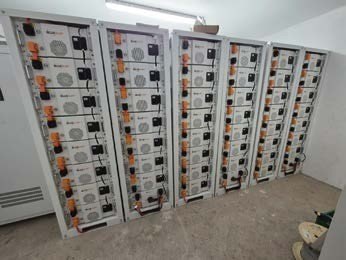
| Resort, 100–140 keys | 55 kW average (rooms, kitchen cold room, front desk, comms, water pump) | 12 hours overnight | About 733 kWh | 3 × 261 kWh liquid-cooled cabinets = 783 kWh |
| Cold storage / food distributor | 40 kW average | 10 hours | About 444 kWh | 2 × 261 kWh cabinets = 522 kWh |
| Commercial office or clinic | 18 kW average | 8 hours | About 160 kWh | 1 × 215 kWh cabinet, or 3 × 60 kWh racks |
Then the recharge side: in The Bahamas a well-oriented array delivers roughly 4.2–4.5 peak sun hours on an average day, so 100 kWp of modules returns about 420–450 kWh a day. A 783 kWh bank paired with 150–200 kWp of array recovers most of a night’s discharge across a normal sunny day, and load shedding covers the rest in a cloudy spell. A diesel generator stays in the design as the third source — not as the primary one.
Two things we will not do: size a battery on nameplate kW instead of measured average load, and quote a runtime figure without stating the load it assumes. If you send us 12 months of bills and a list of critical circuits, the number we return is defensible to your client’s finance team.
The 60 Hz and voltage check before you order
The Bahamas runs a 60 Hz grid. Residential and light commercial service is typically 120/240 V split-phase; larger commercial service is commonly 208Y/120 V or 480 V three-phase. A 50 Hz European-specification inverter will not commission here, and a 230 V single-phase unit wired into split-phase service is a rework, not a firmware setting.
We ship 60 Hz configurations as standard for The Bahamas, and the quotation states frequency, rated AC voltage and listing standard on the datasheet itself. Confirm three things at site before releasing the order: the actual service voltage and phase configuration from the meter or connection point; whether the site stays zero-export or is applying to export; and whether the generator is a two-wire or three-wire start, because that decides how the transfer and the gen-set signalling are wired.
Why 6–8 weeks is the expensive option
Hurricane season runs 1 June to 30 November. That is also when every resort, grocery chain and water utility in the archipelago decides it needs backup, and when freight and installation crews are booked.
Do the timeline arithmetic backwards from an outage: a supplier quoting 6–8 weeks ex-works, plus 3–4 weeks sea freight to Nassau, plus customs clearance, plus URCA review and inspection, puts delivery in the following season. A supplier quoting 1–2 weeks ex-works compresses the same chain by a month and a half, which is often the difference between having the system commissioned before the season and explaining to an owner why it arrived after the storm.
This is the one place where a Chinese factory group has a genuine structural advantage over a US-warehouse distributor: not price alone, but the ability to ship a mixed container — cabinets, inverters, modules, spares — on a two-week clock rather than waiting for a consolidated order.
What we can and cannot reference in The Bahamas
We will not pretend to a Bahamian reference we do not have. As of November 2026 EverRay has no commissioned project in The Bahamas. Anyone who tells you otherwise without a site address is selling you a story.
What we do have is the nearest thing to it: island and Caribbean projects of the same architecture, at the same scale, on grids with the same problems.
- Sint Eustatius, Caribbean Netherlands — 500 kW / 1.29 MWh. Island microgrid with 1,140 modules, a 500 kW inverter and 1,290 kWh of lithium storage: the closest analogue to a Family Island installation we can show.
- Saint Martin — commercial rooftop and storage. Same hurricane belt, same salt-air specification.
- Cuba — 60 kW / 143 kWh. 108 modules, six 10 kW hybrid inverters and 143 kWh of battery, built for daily outage cycling rather than for export.
- Panama — 50 kW / 230 kWh and Guatemala — 700 kW, both commercial self-consumption designs.
The full case library, with capacities and configurations, is on our projects page.
MOQ, lead time and price bands
| Product line | Range | MOQ | Lead time |
|---|---|---|---|
| Solar modules | 440–735 W | 1 pallet | 1–2 weeks |
| Hybrid inverters | 2–150 kW, single and three phase, 60 Hz | 1 unit | 1–2 weeks |
| LiFePO4 batteries | 12.8–76.8 V, 100–628 Ah, rack and wall mount | 1 unit | 1–2 weeks |
| Home energy storage | 3–60 kWh | 1 set | 1–2 weeks |
| Commercial and industrial ESS | 30–500 kW; liquid-cooled 261 kWh cabinets and containers | 1 set | 1–2 weeks |
| Solar pumping | 0.37–11 kW | 1 set | 1–2 weeks |
Indicator bands for planning, not a quotation: LiFePO4 cells trade around USD 65–90 per kWh, 48 V 100 Ah rack batteries at USD 105–145, and C&I cabinets at USD 110–160 per kWh. Send a load profile and a bill, and you get a real number with the duty line broken out separately.
More on the commercial range: commercial energy storage systems. For a worked configuration at the small end of the C&I range, see the 30 kW / 64 kWh system page. Buyers comparing cell-level options should start with our LiFePO4 battery range, and distributors can see terms on the wholesale and distributor page.
Shipping into Nassau, and onward to the Family Islands
Sea freight lands at the Port of Nassau. Commercial imports require a licensed customs broker, and the broker needs the commercial invoice, bill of lading, and a packing list detailed enough to match each line to a tariff heading — which is exactly why the invoice line items matter more here than in most markets.
Batteries move as Class 9 dangerous goods: UN38.3 test summary, MSDS, and compliant packaging are required before the carrier accepts the booking. We ship lithium in certified packaging with the documentation pack attached to the shipment, not emailed afterwards. If your forwarder has not handled Class 9 before, tell us early and we will route through one that has.
For Abaco, Eleuthera, Exuma and the rest of the Family Islands, the onward leg from Nassau moves by mail boat or charter, and schedules are the binding constraint rather than cost. Plan the delivery date around the boat, not around the factory completion date, and if the site is not ready, arrange dry secure storage in Nassau before the container arrives.
How you verify us without taking our word for it
Three routes, all of which we offer in writing:
- Third-party inspection. Commission SGS, BV or TÜV to inspect the production batch against the datasheet before shipment. The report comes to you.
- Your own audit. Send your engineer or a third-party auditor to the plant. Our engineers accompany the visit under a mutual NDA. We do not publish partner plant names or hand out site contacts — we will not put your supply chain in front of your competitor either.
- Documentation first. CE, IEC and UL test reports, UN38.3 summaries, warranty terms and the exact datasheet for the configuration you are buying, before any deposit.
What we do not do is quote you a factory name in a brochure. If your procurement rules require it, that conversation happens at quotation stage under a non-solicitation agreement, not on a web page.
Solar Battery Bahamas — FAQ
Do I need URCA approval for a commercial solar and battery system in The Bahamas?
Yes, for any grid-tied system. Systems up to 100 kW go through the SSRG commercial application with a $150 fee; systems from 100 kW to 1 MW, and off-grid systems under 1 MW, go through RESG with a $250 fee. Both require a licensed electrical contractor, an electrical permit and an approved inspection certificate before the system can be activated. Off-grid systems that never parallel the grid still need the filing when they fall under the RESG scope.
What is the difference between SSRG and RESG in practice?
Size, fee, and submission format — SSRG is the small commercial door up to 100 kW with three paper copies at $150; RESG covers 100 kW to 1 MW with a PDF plus three printed copies at $250. The technical attachments are effectively the same: schematic, equipment datasheets, installation manuals, licensed contractor. Export compensation in both cases is at the utility’s avoided fuel cost, which is why we design for self-consumption and backup.
Are batteries duty-free in The Bahamas?
Not reliably. Solar panels and inverters generally clear under the renewable equipment treatment, while lithium batteries often attract duty and VAT under their own tariff heading, and racking and cabling can follow the standard schedule. We itemise every quotation by equipment type so your broker can file accurately, and we model duty as a separate line rather than assuming an exemption. Company-level concessions such as the SME exemption, FIDEA for Andros and the southern islands, and SERZ for Abaco and Grand Bahama can change the answer — those you apply for directly.
What does electricity cost a commercial site in Nassau?
About US$0.359 per kWh all-in at the February 2026 fuel charge: 14.50 cents base commercial tariff on all units plus 21.4 cents fuel charge at or above 800 kWh. The fuel component is a monthly pass-through, so model it with the latest published figure rather than an annual average, and remember the Bahamian dollar is pegged 1:1 to the US dollar.
How long does shipping take from your factory to Nassau?
Production and dispatch are 1–2 weeks for stock configurations. Sea freight to the Port of Nassau is typically 3–4 weeks depending on sailing and routing, plus customs clearance. Air freight is available for urgent spares. Compare that with the 6–8 week ex-works lead times common in this market, then add the URCA review and inspection before activation.
What is your minimum order quantity?
One pallet for solar modules, one unit for inverters and batteries, one set for home storage, C&I cabinets and pumping systems. There is no container minimum, which matters for a first order or a single-site retrofit.
Can your battery work with the diesel generator I already have?
Yes, and on Family Islands it usually should. Our hybrid inverters support generator input with programmable start and stop, so the battery carries the base load and the gen-set runs only when state of charge falls below its threshold or the load exceeds the inverter’s continuous rating. Tell us whether the generator is two-wire or three-wire start and its kVA rating, and the configuration is set at the factory rather than at commissioning.
Do you have Bahamas project references?
No — as of November 2026 we have no commissioned system in The Bahamas, and we will not claim one. Our nearest references are Sint Eustatius (500 kW / 1.29 MWh island microgrid), Saint Martin, Cuba (60 kW / 143 kWh outage-cycling system), Panama and Guatemala. Capacities and configurations are public on our projects page.
Send a bill, a load list and the system size you are considering, and we will return a configuration, a price with the duty line separate, and the URCA document pack your contractor needs. WhatsApp +86 183-5694-3951 or use the form on our contact page.
Get the 2026 EverRay Product Catalogue
25 pages · solar modules 440-735W, hybrid inverters 2-150kW, LiFePO4 batteries, home & C&I energy storage, solar pumps, lighting and PV cleaning