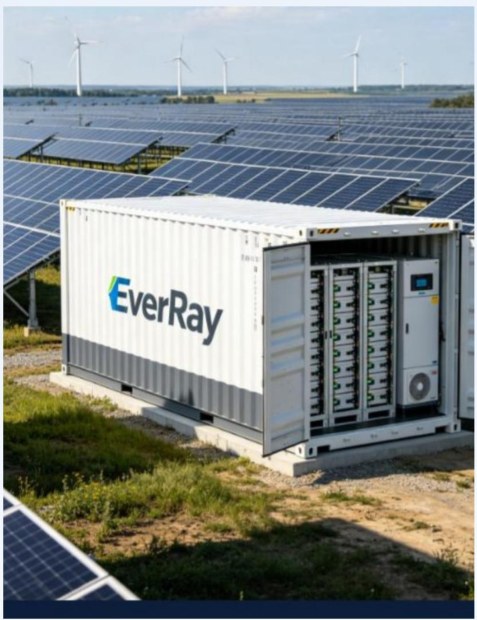
Solar Battery Storage Bulgaria: RESTORE, Prices & 1-2 Week Supply | EverRay
EverRay supplies solar modules, hybrid inverters, LiFePO4 battery cabinets and containerized BESS to Bulgarian developers, EPCs and distributors — MOQ from one pallet or one unit, 1–2 week dispatch on stock configurations, EUR invoicing, and a 1 MW solar plant already delivered inside Bulgaria.
Quick facts for Bulgarian buyers
- MOQ 1 pallet / 1 unit
- 1–2 weeks production and dispatch
- 30–500 kW cabinets, liquid-cooled to 261 kWh
- EUR pricing — Bulgaria joined the eurozone on 1 January 2026
Bulgaria has become, by one widely cited industry measure, the most battery-intensive electricity market in the world. In roughly two years the country went from about 200 MWh of grid-scale storage to an estimated 4.8 GW / 14 GWh in operation by mid-2026, financed by roughly €590 million of EU recovery grants and about twice that again in private capital. Midday wholesale prices now regularly touch zero or below while evening peaks reach €250/MWh — and that spread is exactly what a battery converts into revenue.
This page is written for the buyers who actually procure equipment here: developers adding storage to solar parks, EPCs with delivery deadlines, and distributors serving industrial customers. It covers the market numbers, the grant programmes and what comes after them, where cabinet-scale systems fit, our reference projects in Bulgaria and neighbouring markets, and the supply arithmetic — MOQ, lead time and shipping to Burgas or Varna.
Bulgaria by the numbers: how a 200 MWh market became 14 GWh
The build-out is the fastest storage ramp in Europe, and the reasons matter if you are deciding whether to enter the market now. European recovery funding paid for the first wave, cheap midday solar power created the arbitrage case, and construction deadlines concentrated delivery into a short window.
| Indicator | Figure (as reported, mid-2026) | What it means for equipment buyers |
|---|---|---|
| Operating battery capacity | About 4.8 GW / 14 GWh (project-level database); system operator reported 3,432 MW in May 2026 | The market is real and already operating at scale — suppliers, spares and augmentation demand exist |
| Growth base | From roughly 200 MWh two years earlier; about 3 GWh added in 2025 alone, a top-five EU market that year | Most of the installed fleet is young — O&M, augmentation and expansion contracts follow |
| RESTORE grant programme | €603 million EU facility; €587 million awarded to 82 standalone projects totalling 9.71 GWh; second round closed December 2025 with 31 more projects above 4 GWh | The first wave was grant-driven; new projects now compete on merchant economics |
| Solar installed base | Above 6.5 GW in early 2026 — more than half of national generation capacity | Co-location and retrofitted storage on existing parks is a large addressable segment |
| Curtailment | An estimated 1 TWh of solar output wasted in 2025, roughly 3% of consumption | Every curtailed MWh is a revenue argument for adding storage to an operating park |
| Price spread | Midday prices near or below zero; evening peaks up to €250/MWh; one May 2026 interval saw Bulgaria importing from Greece at €0.01/MWh while domestic power was worth €44.34 | The arbitrage and balancing case does not depend on subsidies |
| National goal | Energy Ministry signalling 10 GWh as a milestone — already passed at project level | Pipeline continues beyond the grant wave |
Flagship projects set the tone: a 602 MWh facility in Burgas delivered by Solarpro Technology with CATL, a 150 MW / 601 MWh standalone battery at Nova Zagora built by Enery with Sungrow and Sunotec in under a year, and OMV Petrom’s final investment decision on the Gabare hybrid project — roughly 415 MWp of solar with a 600 MWh battery inside a €300 million budget. Chinese equipment is already embedded in this market at the top end, which tells you two things: the procurement channel works, and the tier-one utility segment is crowded.
What changes now that the grant wave has landed
The first wave of Bulgarian batteries was built on grants plus unusually wide spreads. The next wave is different, and that difference decides what kind of supplier wins the next round of tenders.
1. Merchant economics replace grants
With close to 10 GWh of subsidised capacity entering service in a short period, batteries increasingly compete against each other for the same arbitrage and balancing revenues. Analysts expect daytime prices to firm as charging demand grows and evening peaks to soften as fleets discharge — which squeezes projects that depend on a single revenue stream. The projects that proceed are the ones stacking revenues: energy arbitrage, balancing and ancillary services, and co-location with existing solar. Equipment cost discipline gets sharper, not looser.
2. The law is being rewritten around PPAs and distributed storage
The Energy Ministry has been preparing amendments to the Renewable Energy Sources Law aimed at long-term power purchase agreements, faster distributed generation and wider storage deployment. For industrial buyers and developers, the direction of travel is clear: more contracted structures, more behind-the-meter installations, and clearer market participation rules for storage. Nobody should build a 2027 investment case on 2024 grant terms.
3. Grid connection is the new bottleneck
Capacity is no longer the constraint — connection queues are. Projects with existing grid access, especially operating solar parks that can add batteries behind an existing connection, have a structural advantage. That is precisely the co-location segment where cabinet-scale and small-container systems are the right tool.
Where cabinet-scale and mid-size storage actually fits in Bulgaria
Honesty first: the GW-tier standalone market buys directly from tier-one battery majors, and that is not our lane. The underserved middle is where we work every day, and in Bulgaria it has four distinct buyers.
| Segment | Typical configuration | Why it buys from EverRay |
|---|---|---|
| Co-location on mid-size solar parks (0.5–5 MW) | 250 kW–1 MW battery, 0.5–2 MWh, cabinet rows or a 20/40 ft container | Captures curtailed midday energy behind an existing grid connection; 1–2 week dispatch fits tight construction windows |
| Industrial and commercial behind-the-meter | 100–500 kW peak shaving and backup, 200–800 kWh | Regulated-price relief for business consumers is gradually unwinding; exposed industrials are re-pricing their own hedge |
| EPCs and balance-of-plant buyers | Battery enclosures, racks, BOS, modules 440–735 W | One supplier for modules plus storage, CE/IEC documentation packs, EVR branding or private label |
| Distributors and installers | Hybrid inverters 2–60 kW, stackable LFP 3–60 kWh, cabinets from 30 kW | MOQ from one unit, EUR pricing, no container minimum — test the market before committing volume |
On grid compliance: Bulgaria runs a standard European 50 Hz network at 400 V three-phase / 230 V single-phase, and our inverters and cabinets ship with CE marking and IEC test reports, plus the grid-code documentation your design engineer needs for the ESO connection file. Full certification references are on our certifications page.
Our track record in Bulgaria and the region
We do not ask Bulgarian buyers to be first. EverRay equipment is already operating in the country and across the region:
- Bulgaria — 1 MW solar power plant, delivered and commissioned, part of our European portfolio
- Serbia — 8 MW ground-mounted solar plant
- North Macedonia — 3 MW / 6 MWh of liquid-cooled commercial storage
- Europe overall — 29 projects across 19 countries, including Italy, Germany and the United Kingdom
Capacities and configurations are public on our projects page. Group-wide, we have delivered 83 reference projects in 52 countries totalling 42.3 MW of solar and over 1 GWh of storage, including a 500 MW / 1 GWh programme in Colombia — scale proof that the same supply chain behind your cabinet has shipped at utility level.
Sizing examples, MOQ and lead times to Burgas or Varna
Three worked configurations
Mid-size co-location (500 kW / 1 MWh): two rows of liquid-cooled cabinets beside an existing 2 MW park. Charges on curtailed midday energy, discharges into the evening peak. As a reference point for budgeting, European trade data puts 20–120 kWh commercial systems around €200/kWh at distribution level — cabinet-scale supply from the factory lands well below that, which is the arbitrage you are selling.
Industrial peak shaving (250 kW / 500 kWh): a single cabinet line that flattens the evening demand peak and carries critical loads through short outages. Typical payback modelling starts from the site’s own demand charges and the regulated-tariff trajectory — send us a load profile and we will run the numbers before you commit.
Distributor starter programme: one pallet of 585 W modules, one hybrid inverter in each power class you sell, and one 30 kW cabinet as a demo unit. No container minimum; you validate demand in Sofia, Plovdiv or Varna before scaling.
MOQ and lead time
| Product line | MOQ | Production and dispatch |
|---|---|---|
| Solar modules 440–735 W | 1 pallet | 1–2 weeks |
| Hybrid inverters 2–60 kW | 1 unit | 1–2 weeks |
| LiFePO4 batteries and cabinets | 1 unit | 1–2 weeks |
| Commercial ESS 30–500 kW / containers | 1 set | 1–2 weeks stock configurations; custom builds quoted separately |
| Home storage 3–60 kWh | 1 set | 1–2 weeks |
Sea freight from Chinese ports to Burgas or Varna typically runs 4–6 weeks depending on routing; some buyers route via Piraeus and truck north. We quote FOB, CIF or DDP with every line item visible — equipment, freight, insurance and import VAT modelled separately. Lithium batteries ship under UN38.3 with full MSDS documentation, which Bulgarian customs checks against the certification file, and eurozone membership since 1 January 2026 means no lev conversion risk in your landed-cost model. Incoterms details are on our Incoterms guide.
Product references: commercial and industrial energy storage systems, LiFePO4 battery line, hybrid inverters 2–150 kW. Distributor terms and regional stocking are on our wholesale and distributor programme page.
Send the project parameters — grid connection status, target kW/MWh, discharge strategy — and we will return a configuration, an EUR price with every cost line separate, and the datasheet pack your connection application needs. WhatsApp +86 183-5694-3951 or use the form below.
Get the 2026 EverRay Product Catalogue
25 pages · solar modules 440-735W, hybrid inverters 2-150kW, LiFePO4 batteries, home & C&I energy storage, solar pumps, lighting and PV cleaning