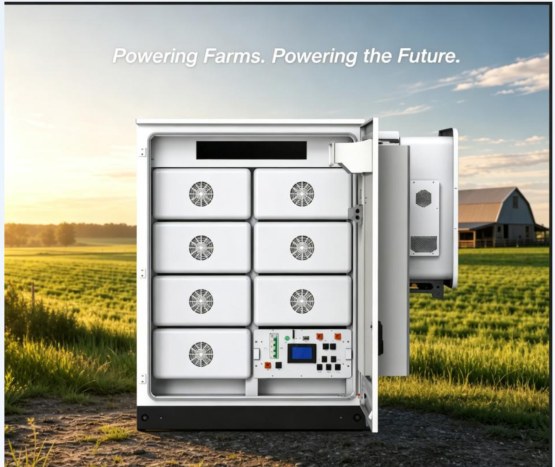
An industrial battery storage system is no longer a pilot project. On commercial and industrial tariffs, the economics have flipped: demand charges, time-of-use pricing and grid outages now cost a factory more in a single year than the storage cabinet costs to buy. Choosing the right commercial and industrial energy storage system is what turns those tariffs into savings. The projects that pay back fastest are usually the least glamorous ones — a cold-storage warehouse shaving a 400 kW peak, a textile mill riding through a two-second dip on a sensitive line.
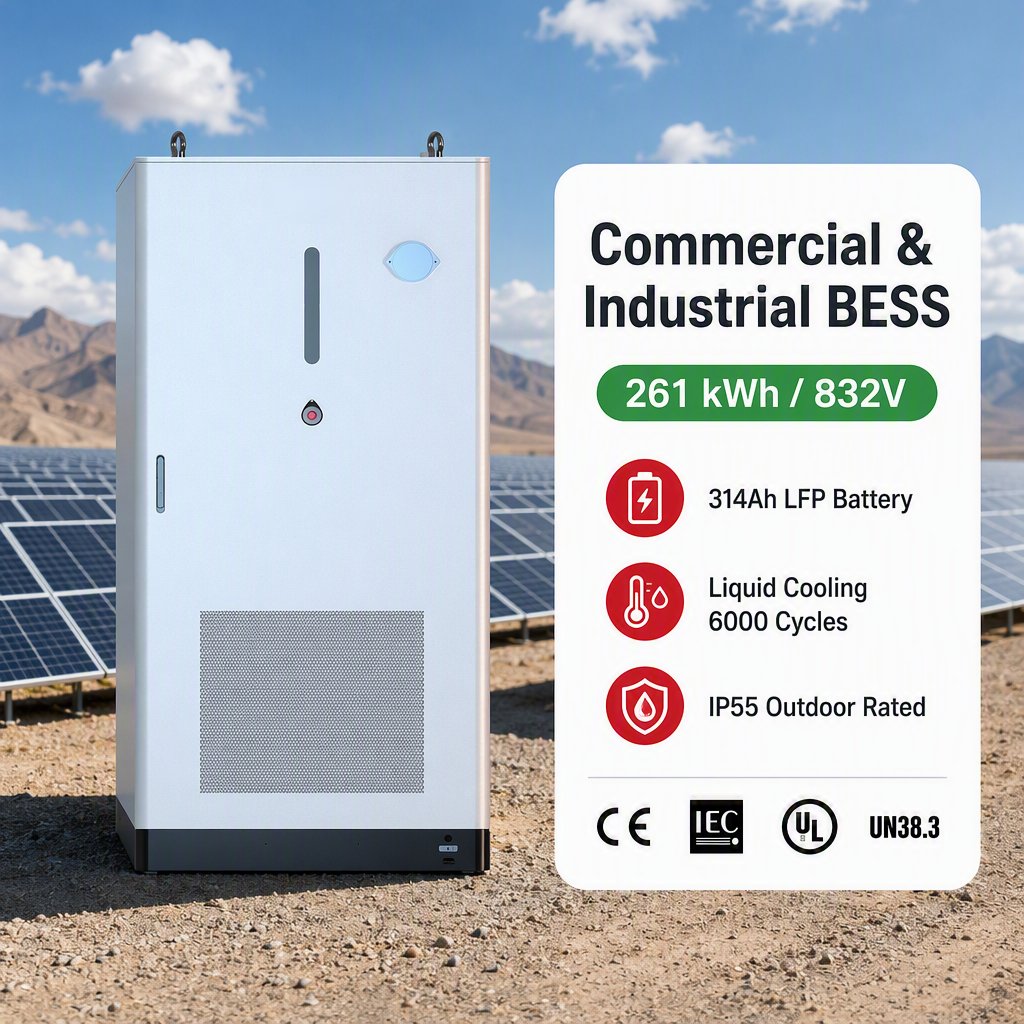
This guide is the sizing and selection method our engineers use when specifying a commercial and industrial energy storage system, from a single 100 kWh cabinet to multi-megawatt containerized plants. It covers how to read your electricity bill, how to calculate capacity, when liquid cooling is worth the premium, and the seven specification mistakes that quietly destroy payback. If you would rather skip the maths, send us one month of load data and we will size it for you — free.
Why a Commercial and Industrial Energy Storage System Pays Back Faster Than You Think
Home storage is driven by self-consumption: you buy less electricity at retail prices. C&I storage is driven by tariff structure, and that is a much stronger lever. An industrial consumer usually pays three separate charges, and a battery can attack all three:
- Energy charge (kWh) — the cost of the units consumed. Storage shifts consumption from expensive peak hours to cheap off-peak hours.
- Demand charge (kW) — a monthly fee based on your highest 15- or 30-minute peak. On many industrial tariffs this alone is 30–50% of the bill. A battery shaves the peak, and the saving repeats every month.
- Penalties and outages — excess reactive power, over-contracted demand and unplanned downtime. Storage absorbs spikes and rides through dips.
That structural difference is why commercial and industrial energy storage systems routinely show three- to five-year payback in markets with steep demand charges, against eight to twelve years for residential systems. It is also why the enquiries we receive for 100–500 kWh C&I cabinets now outnumber residential enquiries from the same markets.
Step 1: Read Your Electricity Bill Before You Read Any Datasheet
Most failed storage projects were sized from a datasheet instead of a bill. Before you look at a single cabinet, pull three things from your utility account:
1. Your Maximum Demand (kW), Not Your Average Load
The demand charge is set by your highest peak in the billing month, measured over a 15- or 30-minute window. That peak is what you are sizing against — not the average power you draw all day. A factory averaging 300 kW with a 700 kW monthly peak has a peak-shaving opportunity far larger than its consumption profile suggests.
2. Your Load Curve Shape
Ask for 15-minute interval data, or at minimum a week of hourly readings. What you are looking for is the shape of the peaks:
| Load curve pattern | What it means | Best fit |
|---|---|---|
| Sharp, short peaks (1–2 h) once or twice a day | Motor starts, chillers, compressors | Power-heavy cabinet, high C-rate, short discharge |
| Long, flat plateau at peak tariff | Sustained production shifts | Energy-heavy cabinet, 2–4 h discharge at full load |
| Two peaks (morning and evening) | Two-shift operation | System with two daily cycles, check cycle-life warranty |
| Flat, continuous load | 24 h process, e.g. cold storage | Peak shaving plus solar firming, not arbitrage alone |
| Fast EV charger spikes | New DC fast chargers on site | Buffer storage to avoid a costly service upgrade |
3. Your Tariff Windows and Rate Structure
Write down the exact peak, shoulder and off-peak hours, and the rate for each. This determines how many hours your battery can discharge at peak tariff per day, which directly sets your daily revenue. A battery that can only discharge for one hour captures far less value than one discharging for four.
Step 2: Calculate the Capacity You Actually Need
Usable capacity is not the nameplate number on the datasheet. Three corrections always apply.
Formula: Required usable capacity (kWh) = Peak to be shaved (kW) × Discharge hours ÷ (Depth of discharge × Round-trip efficiency)
Worked example — a cold-storage warehouse:
| Parameter | Value | Note |
|---|---|---|
| Monthly peak demand | 620 kW | From the utility bill |
| Target peak after storage | 420 kW | Keep below the next demand-charge band |
| Peak to shave | 200 kW | 620 − 420 |
| Discharge window at peak tariff | 2.5 h | From the tariff schedule |
| Energy required at the meter | 500 kWh | 200 kW × 2.5 h |
| Depth of discharge (DoD) | 90% | LFP is routinely cycled to 90% DoD |
| Round-trip efficiency | 90% | PCS + thermal + auxiliary losses |
| Usable capacity required | ≈ 617 kWh | 500 ÷ (0.90 × 0.90) |
| Practical configuration | 2 × 300 kWh cabinets | Or 3 × 215 kWh liquid-cooled cabinets |
Note what happened: a 200 kW / 2.5 h requirement became a 617 kWh order, not a 500 kWh order. Buyers who size on the raw number end up 20% short and lose the demand-charge saving in the first hot month.
Do Not Forget the Power Rating
Capacity (kWh) and power (kW) are separate specifications and both must be satisfied. A 500 kWh cabinet rated at 100 kW cannot discharge 200 kW no matter how much energy it holds. Check the C-rate: a 0.5C system delivers its full rating for two hours, a 0.25C system for four. Industrial loads with motor starts need both a high continuous rating and surge capability — which is exactly the difference between an air-cooled and a liquid-cooled cabinet.
Step 3: Air Cooling or Liquid Cooling — When It Actually Matters
This is the single most consequential specification decision in C&I storage, and it is usually made on price alone. It should not be.
| Factor | Smart air cooling | Liquid cooling |
|---|---|---|
| Typical capacity range | 100 – 261 kWh | 215 – 261 kWh per cabinet, scales to MWh |
| Power rating | 30 – 100 kW | 100 – 125 kW per cabinet |
| Cell temperature spread | Wider, ±5 – 8 °C typical | Tight, typically within ±2 – 3 °C |
| Cycle life in hot or humid climates | Degrades noticeably faster | Stable; thermal management is cell-level |
| Footprint per kWh | Larger | Compact, higher energy density |
| Best for | Temperate sites, modest peaks, cost-driven projects | Hot or humid sites, high C-rates, UL9540 projects, containers |
Our rule of thumb: above 100 kWh, specify liquid cooling unless the site is genuinely temperate and the load curve is gentle. In tropical projects we have measured 25–40% shorter service life from air-cooled cabinets compared with liquid-cooled equivalents at the same duty cycle. Since cycle life sets the warranty and the payback period, that gap erases the upfront saving within the first replacement cycle.
Step 4: Match the Cabinet Format to Your Site
C&I storage is sold in four physical formats. Choosing the wrong one creates civil works, permits and lead-time problems that dwarf the price difference.
| Series | Capacity | Power | Cooling | Form factor |
|---|---|---|---|---|
| Cabinet ESS | 100 – 261 kWh | 30 – 100 kW | Smart air cooling | Indoor / outdoor cabinet, fast on-site installation |
| Liquid-Cooled ESS | 215 – 261 kWh | 100 – 125 kW | Liquid cooling | Compact cabinet, high energy density, UL9540 compliant |
| Parallel Expansion | 300 / 400 / 500 kWh | 200 – 500 kW | Liquid cooling | 2 – 4 cabinets paralleled on one EMS, single point of control |
| 20 ft Container | up to 642 kWh | up to 250 kW | Liquid / air options | Standard 20 ft container, transport-ready, plug-and-play |
| 40 ft Container | up to 1.72 MWh | up to 500 kW | Liquid cooling | Utility-scale plant building block, 500 MW / 1 GWh proven |
Indoor or Outdoor?
Indoor installation saves on enclosure cost but adds ventilation, fire-separation and access requirements that many building codes handle strictly. Our outdoor cabinets are IP55 rated and need no building works — for most retrofits this is the faster and cheaper route, even before you count the permit.
What Does a Cabinet Actually Occupy?
Plan the footprint early. A 261 kWh liquid-cooled cabinet measures roughly 2155 mm (H) × 1110 mm (W) × 1410 mm (D) at about 2,500 kg. Add service clearance of at least 800 mm on the front face and confirm the floor loading and door width before the delivery truck arrives.
Step 5: Battery Chemistry, Safety Certification and BMS
These three items decide whether your insurer, your utility and your safety auditor will accept the installation.
Cells: Grade-A LiFePO4 Only
Specify Grade-A prismatic LiFePO4 cells from a Tier-1 supplier, with a documented cell datasheet — not second-life, not refurbished, not blended stock. Ask for the cycle-life test report. Our C&I series is rated at 6,000–8,000 cycles with a 10-year battery warranty. For a system cycling once per day, that is comfortably beyond 15 years of operating life. Anything advertised at 3,000 cycles is a residential-grade cell in an industrial enclosure.
Certification: UL9540, UL9540A and IEC 62619
In North America, UL9540 is the system-level listing and is non-negotiable for permitted installations; UL9540A is the thermal-runaway test report your fire authority will ask for. Outside North America, IEC 62619 covers industrial battery safety and IEC 62477 or IEC 62109 covers the power conversion side. Cell-level safety design should include integrated aerosol or gas fire suppression, and enclosure-level venting sized to the worst-case gas release. Ask for the certificate numbers and verify the scope — a cell certificate is not a system certificate.
BMS: Protection at Three Levels
A credible industrial BMS protects at cell, module and rack level against overcharge, over-discharge, over-temperature, short circuit, thermal runaway and arc fault, and it logs the events. If the BMS cannot export an event log, you cannot prove what happened after an incident.
Step 6: EMS, Grid Codes and What It Integrates With
The EMS is what turns a battery into revenue, and it is the specification most often under-scoped. Confirm four things in writing:
- Operating modes — peak shaving, peak-valley arbitrage, solar self-consumption, backup, and demand response. A cabinet that only does one mode is a cabinet you cannot monetise flexibly.
- Communication interfaces — RS485, CAN and Modbus TCP as standard, plus the protocol list for third-party PCS, inverters and SCADA. If it cannot speak Modbus TCP, your building-management system will never see it.
- Remote monitoring and scheduling — real-time state of charge, event logs, and the ability to change schedules without a site visit.
- Grid-code configuration — the exact national grid code you must comply with, plus MV transformer connection and on/off-grid switching if the site needs islanding or backup.
Where a site also generates solar, the storage EMS has to coordinate with PV rather than compete with it. In those projects we specify the battery and the hybrid inverters together so the charge/discharge logic is designed once, not bolted together afterwards. For solar-firming duties in particular, confirm that the EMS can prioritise charging from PV surplus while reserving enough state of charge for the evening peak.
Step 7: Plan for Expansion and Service From Day One
Very few industrial loads stay the same size. Design the electrical room for the system you will need in five years, not the one you can afford today.
- Parallel expansion path — confirm the cabinets can be paralleled onto a single EMS. Our 300 / 400 / 500 kWh configurations are 2–4 cabinets on one control point, and the container range continues the same architecture up to 1.72 MWh per 40 ft unit.
- Spare capacity in the switchgear and transformer — the cheapest upgrade is the one you provisioned at build stage.
- Service and spares — front-access module design, local spare-module availability and a documented replacement procedure. Ask what happens if a module fails in year four.
- Fire suppression and detection maintenance — an annual check on the aerosol or gas system, plus detector calibration.
- Monitoring ownership — confirm you keep access to the data platform and that the account is in your company name, not the installer’s.
Sizing Chart: Typical C&I Sites
Starting points only — always confirm against real load data.
| Site type | Typical peak demand | Shaving target | Suggested capacity |
|---|---|---|---|
| Retail store / restaurant | 80 – 150 kW | 30 – 50 kW | 100 – 150 kWh |
| Office building | 150 – 300 kW | 50 – 100 kW | 200 – 261 kWh |
| Light manufacturing | 300 – 600 kW | 100 – 200 kW | 300 – 400 kWh |
| Cold storage / food processing | 500 – 900 kW | 150 – 300 kW | 400 – 500 kWh, liquid cooled |
| Factory with 2–3 shifts | 800 kW – 2 MW | 300 – 600 kW | 500 kWh – 1.72 MWh, containerized |
| Solar plant firming | Project-specific | To PPA requirement | 20 ft / 40 ft container blocks |
Seven Specification Mistakes That Destroy Payback
Each of these has cost a real project its business case.
- Sizing on capacity and ignoring the power rating. A 500 kWh cabinet rated at 100 kW will not shave a 200 kW peak, and the buyer discovers this only after commissioning.
- Using nameplate SOC instead of usable capacity. Forgetting depth-of-discharge and round-trip efficiency leaves the system 20% short of the target — enough to keep paying demand charges.
- Specifying air cooling for a hot or humid site. The cabinet arrives within budget and fails the cycle-life expectation two years later, when the warranty claim is contested.
- Ignoring the tariff structure. Without knowing exactly which hours carry the peak rate, the battery cannot be scheduled for the hours that produce revenue.
- Accepting a cell certificate as a system certificate. UL9540 and UL9540A apply to the assembled system. A cell-level report will not satisfy the fire authority or the insurer.
- Forgetting the interconnection and demand-charge rules. Some utilities rebate peak shaving, others treat it as an unregulated service. Confirm the programme rules and the interconnection timeline before ordering.
- Buying the cabinet without a service plan. Storage is a 10–15 year asset operating in a 5-year-contract supply chain. Confirm spare-module availability and response times in writing.
Frequently Asked Questions
How do I choose between a 100 kWh, 200 kWh and 500 kWh cabinet?
Size on your load profile first, not on a round number. Take your maximum demand (kW), the length of your peak-shaving window in hours, and your daily cycling pattern, then calculate usable capacity with depth-of-discharge and efficiency losses included. As a rule of thumb: retail and restaurant sites land at 100–150 kWh, offices and small industrial loads at 200–261 kWh, and factories or cold-storage warehouses at 400–500 kWh. Send your electricity bill and one week of load data and we will confirm the size before you commit.
How much can storage reduce my demand charges?
On typical industrial tariffs, a correctly sized system reduces monthly demand charges by 20–30%. The realistic ceiling is set by how much of your peak occurs inside the peak-tariff window and how long your battery can sustain the discharge. Send us a bill with your 15-minute peak data and we will model the saving for your specific tariff.
Is liquid cooling always better than air cooling?
Not always, but far more often than buyers assume. Above 100 kWh we recommend liquid cooling unless the site is genuinely temperate and the load curve is gentle. In hot or humid climates air-cooled cabinets degrade noticeably faster — in our tropical projects we have measured 25–40% shorter service life than liquid-cooled equivalents at the same duty cycle, which erases the upfront price advantage.
What certifications do I need for a permitted installation?
For North America, UL9540 is the system-level listing and UL9540A is the thermal-runaway test report your fire authority will request. Outside North America, IEC 62619 covers industrial battery safety, with IEC 62477 or IEC 62109 for power conversion. Verify the certificate scope covers the assembled system, not just the cells, and confirm the documents are issued to a legal entity that can support a warranty claim.
Can the system expand after installation?
Yes, if it is designed to. Our cabinets parallel onto a single EMS, so a 300 kWh installation can grow to 400 or 500 kWh by adding cabinets rather than replacing equipment. Containerized systems continue the same architecture up to 1.72 MWh per 40 ft unit. The constraint is usually the switchgear and transformer capacity, so provision spare capacity at build stage.
What is the delivery scope and lead time?
Typical scope is the cabinet or container with integrated BMS and EMS, documentation for the tender package, and DDP shipping to your site. Lead time depends on configuration and destination; tell us your port and target commissioning date and we will confirm a schedule with the quotation. As a one-stop sourcing partner working with 20+ audited factories, we can also supply the PV, inverters, LiFePO4 batteries and balance-of-system items on the same order.
Do you support tender and EPC projects?
Yes. We prepare the technical documentation, datasheets, certificates and compliance statements that tender packages require, and our engineers support your EPC contractor through design review and commissioning. For reference, our largest project is a 500 MW / 1 GWh installation in Colombia, with additional C&I deployments across Europe, Africa, the Middle East, Latin America and Southeast Asia. Project references and reference letters are available on request during the tender stage.
Get a Quote for Your Solar Project
Tell us your destination market and requirement. We reply within 24 hours on business days with specifications, certificates and pricing — no obligation.
Get the 2026 EverRay Product Catalogue
25 pages · solar modules 440-730W, hybrid inverters 2-150kW, LiFePO4 batteries, home & C&I energy storage, solar pumps, lighting and PV cleaning