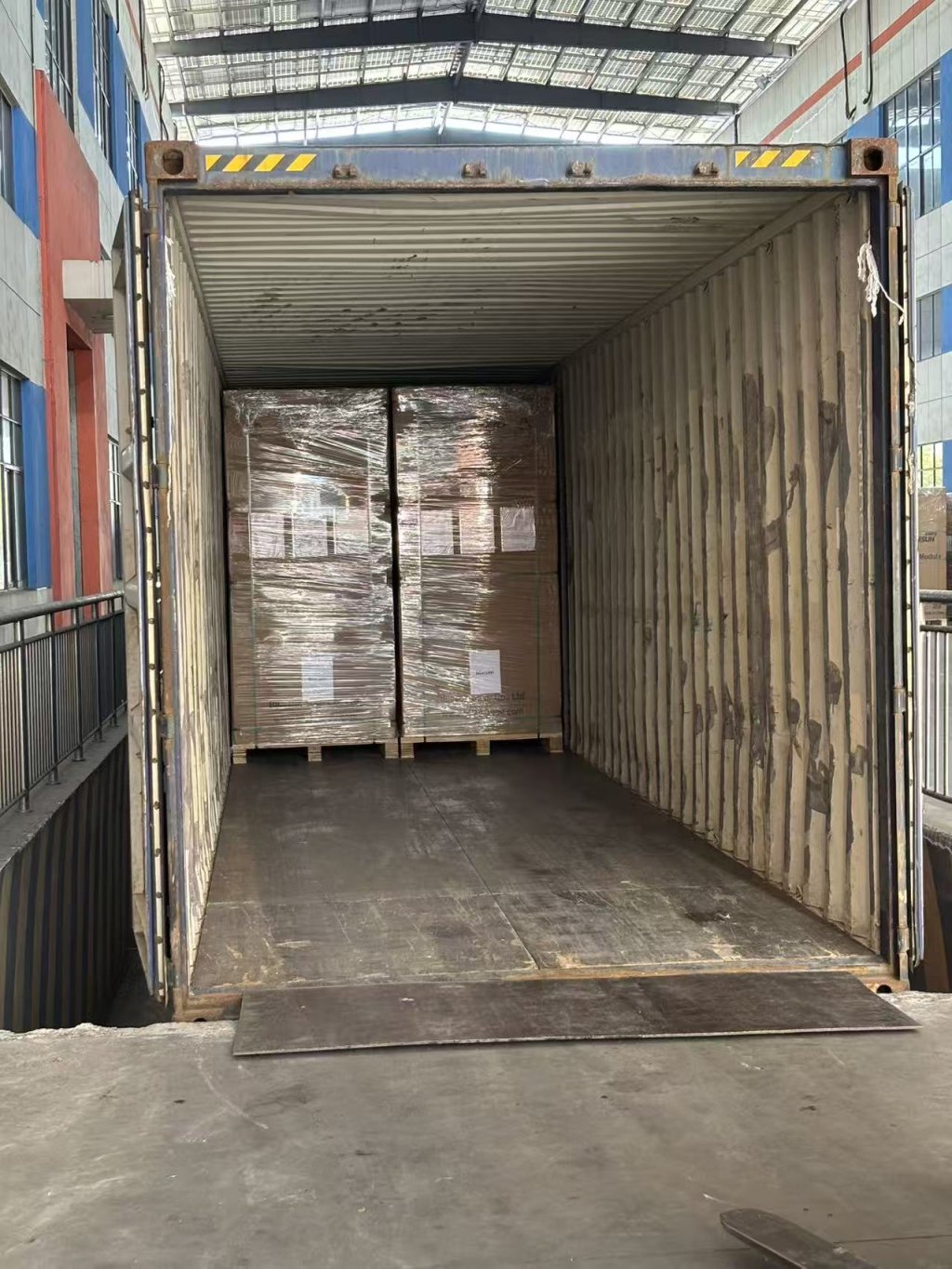
Solar Battery Supplier in Ecuador: Wholesale Price, MOQ and the 15 December 2026 Deadline
EverRay supplies solar modules, hybrid inverters, LiFePO4 batteries and containerised energy storage to Ecuadorian distributors, installers and industrial buyers — MOQ from one pallet or one unit, 1–2 week lead time from stock-standard configurations, and DDP delivery to Guayaquil, Puerto Bolívar and Manta. This page is written for the twelve weeks that matter: Executive Decree 32 gives every high-voltage consumer in Ecuador until 15 December 2026 to cover its own demand with self-generation, and only about a quarter of the affected companies had full capacity in place as of October.
We are not new to the country. Three Ecuadorian systems are already commissioned: an 800 kW ground-mounted array on eight 100 kW on-grid inverters (2025), a 150 kW / 286 kWh hybrid installation with a 286 kWh lithium bank (2026), and a 40 kW / 60 kWh hybrid system (2025). The 2026 unit is the shape of the Decree 32 job — daytime industrial offset plus a battery that carries the load when the grid does not.
Below: what the deadline actually requires, why a diesel genset cannot get you there in time, how the October 2026 tariff reform changed the payback maths, what our price list and MOQ look like, and what your shipment will pay at the port. Spanish-language buyers can start from our Spanish product overview.
The Deadline Nobody Can Meet With a Diesel Genset
Executive Decree 32, published in the Registro Oficial on 15 June 2025, obliges regulated high-voltage consumers — AV1 and AV2, which covers mining, steel, cement, shrimp farming, food processing and general manufacturing — to install generation covering their own demand within eighteen months. That clock ends on 15 December 2026. Roughly 170–180 companies are caught by it. Industry reporting in October put the number with full self-generation at around 47, with some 135 still short.
The reason the gap is still open is arithmetic, not intent. A thermal solution costs USD 500,000–600,000 per megawatt, needs about four months for equipment import and a minimum of six months for installation before it runs. Anyone starting in October 2026 cannot finish a thermal plant before the deadline. A solar-plus-storage system is the only route that fits inside the window: modules and batteries ship in weeks, not quarters, and a 500 kW / 1 MWh installation is a site works programme measured in weeks.
| Route to compliance | Equipment lead time | Install to first kWh | Fuel or marginal cost | Fits 15 Dec 2026? |
|---|---|---|---|---|
| Diesel or gas genset | ~4 months import (per industry estimate) | 6 months minimum | Fuel exposed to import prices; runs at USD 0.10–0.15/kWh in a deficit year | No, if started now |
| PV + LiFePO4 storage | 1–2 weeks (standard configurations) | 1–3 weeks for 100–500 kWh | Near-zero marginal cost after capex | Yes, if ordered in the next two weeks |
| Buy thermal power from the state scheme | — | — | Transferred thermal cost, permanent tariff exposure | Compliance, not economics |
One more detail that decides whether the system is worth anything: the decree requires you to cover your demand, and surplus may be sold to the grid under ARCONEL rules. A PV array without storage covers demand at noon and nothing at 20:00, when the rationing schedule actually bites. Storage is what turns a compliance asset into a dispatchable one.
The Tariff Reform That Changed the Maths in October
On 1 October 2026 ARCONEL put new tariffs in force for AV1 and AV2 consumers. The previous average sat near USD 0.12/kWh; the new values reach USD 0.3509/kWh in certain high-voltage industrial categories during peak periods. Since 22 September 2026, 185 AV1 and AV2 companies have also been on a temporary scheme that cuts the electricity they draw from the national system each week, with reductions observed between 135 and 200 MW in the first days.
Translate that into a storage business case. One 1 MWh cabinet-class battery, cycled once a day:
- Usable energy at 90% depth of discharge: 900 kWh. Delivered after 90% round-trip efficiency: about 810 kWh.
- If it displaces purchases at USD 0.35/kWh: about USD 283 per day, or roughly USD 93,000 a year at 330 operating days.
- If it is charged from grid at an off-peak USD 0.12 and discharged at USD 0.35, the spread is USD 0.23/kWh: about USD 186 per day, or USD 61,000 a year.
- Against a market system price of USD 90–140/kWh for container-class LFP (before PCS, installation and network charges), simple payback lands between roughly 1.0 and 2.3 years.
Two honest caveats. First, those are before PCS, BOS, installation and the distribution network charges (peajes) that self-supply customers continue to pay under the fourth transitional provision of ARCONEL-005/24, with the new treatment applying from 28 February 2029. Second, half-hourly load shape decides everything: send us twelve months of bills and the interval data if you have it, and we will model your case instead of quoting a brochure number.
What Sells in Ecuador — Segment by Segment
Ecuador is not a single market. The coast (Guayaquil, Manabí, El Oro) buys for shrimp farms, banana and rice irrigation, cold storage and port logistics. The sierra (Quito, Cuenca, Ambato) buys for altitude, hotels and residential backup. The oriente buys off-grid. Sizing follows the load, not the catalogue.
| Buyer | Typical system | Why it wins here |
|---|---|---|
| Households, sierra and coast | 5–15 kWh wall or stackable + 5–12 kW hybrid inverter | Long outages rather than short flickers; two to three hours of critical load is the entry requirement, not one hour |
| Shops, clinics, hotels | 30–64 kWh rack + 30–60 kW three-phase hybrid | Whole-building ride-through through the 09:00–23:00 restriction window |
| Factories, cold storage, agro-industry | 100–225 kWh HV rack, or 261 kWh liquid-cooled cabinet | Peak-rate displacement at USD 0.35 and Decree 32 compliance in one asset |
| Mines, large plants, utility-scale | Containerised 1–5 MWh, PCS-coupled | Self-generation obligation plus surplus sale to the grid |
| Irrigation and aquaculture | 0.37–11 kW solar pumping, DC or AC | Replaces diesel pumps on the coast where the grid is least reliable |
The 60 Hz Check Before You Order
Ecuador runs at 60 Hz, with 120/240 V split-phase service in most homes and 220 V three-phase in commercial and industrial premises. That is not the European specification most Chinese exporters quote by default, and a 50 Hz inverter that commissions in Bulgaria will not commission in Guayaquil. Modules and LiFePO4 batteries are frequency-agnostic; inverters and PCS are not.
We confirm frequency, voltage, phase configuration and grid-protection settings in writing on every Ecuadorian quotation, and we will not ship a unit whose nameplate does not match your site. If you are importing for resale, we will also state on the datasheet which variant you are buying, so your installer does not discover it on the wall.
Price List, MOQ and Lead Time — in Writing
| Product line | Range | MOQ to start | Lead time |
|---|---|---|---|
| Solar modules | 440–735 W, mono facial / bifacial / N-type | 1 pallet | 1–2 weeks |
| Hybrid inverters | 2–150 kW, single / split / three phase | 1 unit | 1–2 weeks |
| LiFePO4 batteries | 12.8–76.8 V, wall / rack / movable | 1 unit | 1–2 weeks |
| Home energy storage | 3–60 kWh all-in-one and stackable | 1 set | 1–2 weeks |
| C&I energy storage | 64–500 kWh cabinets, containers to 1.72 MWh | 1 set | 1–2 weeks (containers per configuration) |
Payment: 30% deposit, 70% against pre-shipment inspection and shipping documents, or a confirmed letter of credit. Custom-configured and OEM-labelled orders run 2–4 weeks — if your deadline is 15 December, stay on standard configurations. Indicative market ranges for context, not our quote: LFP cells USD 65–90/kWh, 48 V 100 Ah packs USD 105–145, C&I cabinets USD 110–160/kWh, containerised systems USD 90–140/kWh. Quote requests answered within 24 hours, in English or Spanish.
Import: Duty, VAT, ISD and the October 2026 VAT Plan
Four numbers decide your landed cost, and three of them are moving.
- Duty. Lithium storage batteries sit under HS 8507.60, inverters under 8504.40, modules under 8541.43. Ecuadorian MFN on grid-storage batteries is quoted by tariff aggregators at around 10%, on modules at roughly 3.5% — treat both as indicative and have your agente aduanal confirm the eight-digit code before you commit a price.
- VAT. Standard IVA is 15%. Solar PV equipment and accessories were zero-rated from 11 January 2024 under article 55 of the income tax law as reformed by the Energy Competitiveness Law. Batteries imported on their own do not automatically inherit that treatment — the classification argument is worth having with your broker before, not after, the shipment.
- The October 2026 plan. On 5 October 2026 Primicias reported a government plan to remove the 15% VAT and the 5% currency outflow tax (ISD) on imported equipment for private generation and storage projects, starting 6 October. We have not seen the official text, and neither had the tax specialists quoted in that report. Do not build a landed-cost model on it yet; ask your broker to confirm the resolution before you rely on the exemption.
- ISD. The 5% tax on outbound foreign currency payments is charged by the Ecuadorian bank, not by us. It changes the effective cost of paying a Chinese supplier directly, and it is the single most common surprise in a first Ecuadorian purchase. Structure the payment with your bank or your offshore entity before signing.
Sizing Storage for a 14-Hour Outage Pattern
Ecuador’s constraint is duration, not power. In the 2024 dry season, restrictions ran up to fourteen hours a day, and the same pattern returned in the 2026 deficit. A battery sized on a European two-hour outage will be empty by lunchtime. The formula we use:
Installed kWh = (critical kW × hours of autonomy) ÷ (depth of discharge × round-trip efficiency)
Worked example: 100 kW of critical load (one production line, cold room, or the pumps that cannot stop), six hours of autonomy, 90% DoD, 90% efficiency — 100 × 6 ÷ 0.81 = about 741 kWh installed. If that load is a mine haulage circuit at 800 kW for eight hours, the answer is 7.9 MWh, and the conversation moves to containerised systems and PCS sizing. Both are quotes we can produce from your bill and your load list within 24 hours.
How You Verify Us — Without Taking Our Word for It
- Third-party audit. We commission independent inspection of the production lines we use and share the report with the plant name redacted and a plant code in its place. You get the findings, not our supplier list — that protection is deliberate, and it is the same protection that keeps your pricing stable.
- Your own auditor. SGS, BV or TÜV can inspect on your behalf; the plant name is disclosed to the auditor under NDA, not to the market.
- Accompanied factory visit. Fly with our engineer, two-way NDA signed before arrival, no supplier contacts left on site.
- References. 52 countries, 83 projects, 42.3 MW delivered. In Ecuador: 800 kW on-grid (2025), 150 kW / 286 kWh hybrid (2026), 40 kW / 60 kWh hybrid (2025). Regionally: a 500 MW / 1 GWh programme in Colombia, a 100 kW / 385 kWh commercial system in the Philippines, 1 MW installations in Bulgaria and the Maldives. Commissioning reports and site photographs are available under NDA; the project portfolio is public.
Solar Battery Supplier Ecuador — FAQ
What is the minimum order for Ecuador?
One pallet of modules, one inverter, one battery, or one complete C&I set. Trial orders are normal for a first shipment; we would rather prove the documentation on a small order than lose a year on a large one.
Can you deliver DDP to Guayaquil, Manta or Puerto Bolívar?
Yes. We quote DDP with duty and VAT shown separately so you can see exactly what the exemption or the MFN line does to your cost. ISD remains a buyer-side cost and is never buried in the DDP price.
Do you have a project reference in Ecuador?
Three. An 800 kW on-grid array commissioned in 2025 on eight 100 kW inverters, a 150 kW / 286 kWh hybrid system delivered in 2026, and a 40 kW / 60 kWh hybrid system in 2025. Regionally we also reference a 500 MW / 1 GWh programme in Colombia, 1 MW installations in Bulgaria and the Maldives, and a 100 kW / 385 kWh commercial system in the Philippines. Commissioning reports available under NDA.
Can you meet the 15 December 2026 deadline?
Standard configurations leave our warehouse in 1–2 weeks. Sea freight to Guayaquil runs roughly 30–40 days plus clearance. An order placed in the first half of November lands in December; an order placed later should target critical-load coverage first and expansion after the deadline, which is a legitimate compliance position and a far cheaper one than a thermal plant you cannot finish.
Do your inverters work at 60 Hz and 120/240 V?
Split-phase and three-phase configurations are available, and frequency, voltage and grid-protection settings are confirmed in writing before shipment. Do not assume a European-specification unit will commission in Ecuador — that mistake is common and expensive.
Who manufactures the equipment?
Everything ships under the EVERRAY brand to our own specification through an integrated manufacturing and trading model, with more than twenty audited partner plants behind the range. We do not publish plant names, for the reason in the verification section above, and we welcome your auditor.
What certifications come with the shipment?
CE and IEC 62619 / IEC 63056 for batteries, IEC 62109 for inverters, UN38.3 test summaries and MSDS for transport, and UL where the destination or the lender requires it. Full model-level test packs travel with the commercial invoice.
What will my shipment actually pay at the port?
Modules around 3.5% MFN or lower under an applicable agreement, batteries around 10% MFN, plus 15% IVA on the landed value unless a valid zero-rating applies. Confirm the eight-digit code and the VAT treatment with your broker in advance; we supply the classification argument and the test pack that supports it.
Send your load list and get a DDP quote within 24 hours → | WhatsApp: +86 183-5694-3951 | Email: info@everraysolar.com
Buyer’s guides: Become a solar distributor · Solar battery wholesale price 2026 · 48 V vs high-voltage battery · Commercial and industrial energy storage
Or fill in the form below and our team will reply within 24 hours.
Get the 2026 EverRay Product Catalogue
25 pages · solar modules 440-735W, hybrid inverters 2-150kW, LiFePO4 batteries, home & C&I energy storage, solar pumps, lighting and PV cleaning