48V vs high voltage battery banks is a sizing decision, not a preference. Here is the arithmetic.
Under about 20 kWh, specify 48V — it is cheaper per kWh, serviceable by any local electrician, and the current is manageable. Between 20 and 60 kWh either class works, and the choice comes down to serviceability versus footprint. Above 60 kWh in commercial or industrial work, high voltage racks and cabinets win, because the alternative is not a cheaper system — it is a thicker cable, a bigger breaker and a hotter battery room.
That is the whole answer. The rest of this guide shows the arithmetic behind it, so you can check any quote — ours included — instead of taking a supplier’s word for which class is “better”.
Same 30 kW, eight times the current
A battery bank does not deliver kilowatts directly. It delivers amps at whatever voltage the bank is built at, and the inverter converts. Hold the power constant and lower the voltage, and the current rises in inverse proportion.
| Bank configuration | Current at 30 kW discharge | What it implies on site |
|---|---|---|
| 51.2V (48V class), 16S | 586 A | Parallel cable runs, 630 A class breaker, busbar and terminal heating become the design driver |
| 204.8V HV rack (4 × 51.2V modules) | 146 A | One cable run, 200 A class breaker, standard cabinet wiring |
| 358.4V cabinet (7 modules) | 84 A | Standard C&I cabinet practice, thin cable, low voltage drop |
Resistive loss in a conductor scales with the square of the current. At the same cable cross-section, moving from 146 A to 586 A multiplies copper loss by roughly sixteen; against a 358.4V cabinet the multiplier is closer to forty-eight. In practice nobody keeps the same cable — they buy more copper until the loss is acceptable, which is exactly the point: 48V at 30 kW is not a cheaper system, it is the same system with the cost moved into copper, breakers, terminals and heat.
Heat is the part buyers underestimate. A battery room that dumps an extra kilowatt or two into its own wiring needs more ventilation or more air conditioning, and that load runs 8,760 hours a year. It never appears on the quotation.
The three voltage families, mapped to real products
“High voltage” is not one thing. It covers rack systems in the 200–800V band and container systems above 1,000V DC, and they behave differently in procurement.
| Family | Specification from our current range | Where it fits |
|---|---|---|
| 48V class (51.2V nominal, 16S) | 100Ah / 200Ah → 5.12 / 10.24 kWh wall or stack units; 300Ah / 314Ah / 346Ah / 628Ah movable series → 15.4 / 16.1 / 17.7 / 32.2 kWh | Residential ESS, telecom sites, off-grid cabins, 48V hybrid inverters |
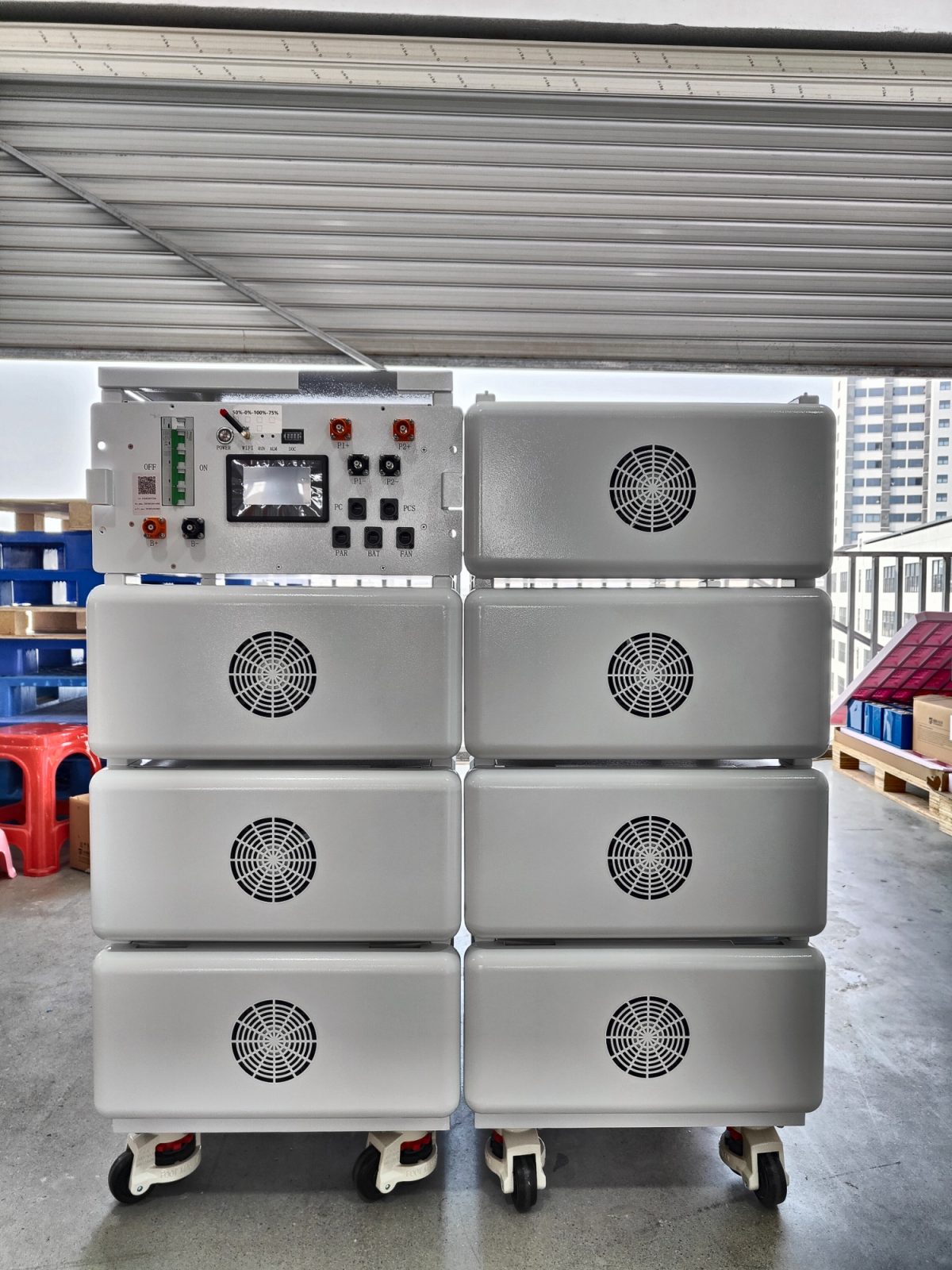
| HV rack (200–800V) | 204.8V / 314Ah racks built from four 51.2V modules in series, 64.3 kWh actual per rack, expandable 64–225 kWh | Small factories, clinics, cold rooms, 30–50 kW three-phase hybrid systems |
| HV cabinet / container (1,000V+) | 76.8V / 314Ah / 24.12 kWh modules, 4–11 per cabinet → 96–265 kWh; 358.4V 112.5 kWh pre-integrated cabinet with 150 A max charge and discharge; containerized systems to 1.72 MWh | C&I peak shaving, microgrids, utility-side and island projects |
Our 76.8V / 314Ah module is worth a note, because it sits between the classes. At 24.12 kWh per module, a cabinet reaches 261 kWh with ten modules instead of needing twenty 51.2V units in series and parallel — fewer strings, fewer interconnects, fewer failure points. It is the reason our standard C&I cabinet is built on that module rather than on 48V hardware.
Where 48V genuinely wins
The case for 48V is not nostalgia. It holds in four situations.
Small banks. Below 20 kWh, the current at realistic discharge rates stays in the tens of amps. Cable and breaker cost stays trivial, and the low-voltage premium of HV hardware is not repaid by anything.
Serviceability. A 48V bank can be diagnosed and repaired by a local technician with a multimeter and a laptop. An HV rack needs the manufacturer’s BMS tooling and, in most jurisdictions, a qualified person for work on the DC bus. On a remote site, that difference can be weeks of downtime.
Mixed-brand retrofits. 48V hybrid inverters are the most common and the most interchangeable. HV systems depend on a BMS-to-inverter communication handshake, and getting a third-party HV battery to talk to an existing inverter is where projects stall.
Stepwise growth. Adding one 5.12 kWh unit to a 48V bank is a same-day job. Adding capacity to an HV rack usually means adding a module to a string and re-commissioning, which is a scheduled visit.
Where high voltage wins, and why it wins earlier than most buyers expect
Once a site crosses roughly 40 kWh, three effects compound.
Cable and switchgear cost stops being a rounding error. The difference between 586 A and 146 A is not one cable size, it is a different class of hardware: parallel runs, a larger breaker, a bigger enclosure, more terminals to torque and inspect.
Voltage drop stops being negligible. On a 20 m DC run at 586 A, drop and loss both climb fast; the installer compensates with copper, and the copper is charged to the project but never appears on the datasheet comparison.
Cabinets get integrated. Above 100 kWh, buyers stop assembling components and start buying cabinets: pre-wired, factory-tested, with the BMS, cooling and fire protection inside one enclosure. Those products are HV by design. Our 261 kWh cabinet and the 112.5 kWh pre-integrated unit are both examples — the 112.5 kWh cabinet runs a 358.4V bank with 150 A maximum charge and discharge, which works out to roughly 54 kW, about 0.48C on a 112.5 kWh bank. That is deliberate: a C-rate matched to a two-hour peak-shaving duty rather than to a headline number.
Parallel expansion: the limit nobody quotes
Both classes can be paralleled, but the failure modes differ.
48V banks parallel easily at two or three units. Beyond roughly six, circulating current between units with slightly different internal resistance and state of charge becomes a real problem, and you need a master-slave arrangement with proper current sharing. Sellers who quote “up to 16 in parallel” rarely mention that the last eight need a different control architecture.
HV racks expand by adding modules in series and racks in parallel, with a master BMS supervising. The trade-off is that a single module fault can take an entire string offline until it is replaced — the bank does not gracefully degrade the way a parallel 48V bank does. Ask any HV supplier what happens to available capacity when one module fails, and whether the system keeps running at reduced power. The answer separates good designs from catalogue designs.
Safety and certification: what to ask for by class
Both classes need cell-level certification: IEC 62619 for stationary lithium safety, UN38.3 for transport, and CE for the EU market. Above that, the requirements diverge.
For HV systems, ask for the rack-level or cabinet-level test evidence, not just the cell certificate — UL 9540 or UL 9540A at system level where the project is US-bound or specified by an insurer, and a clear statement of the DC arc-fault strategy, the insulation monitoring arrangement and the fire suppression approach inside the cabinet. A cell certificate alone tells you very little about a 1,000V cabinet.
For 48V systems the questions are simpler but still worth asking: cell grade, BMS protection set (over-current, over-temperature, cell balancing, remote diagnostics), and whether replacement BMS modules are available as spares. Our battery range ships UN38.3 test reports and MSDS with every shipment, which matters more than it sounds when the freight forwarder asks.
Cost structure: where the money actually goes
Per-kWh purchase price is the least useful number in this comparison, because it excludes everything that changes with voltage class.
| Cost item | 48V class | HV rack / cabinet |
|---|---|---|
| Battery cost per kWh | Lower at small volumes | Higher per kWh, but falls with cabinet integration |
| BMS | One BMS per unit, cheap to replace | Master-slave, higher cost, proprietary tooling |
| DC cable and busbar | Rises steeply with power | Modest at any power |
| Breakers and switchgear | Large frame devices above ~20 kW | Standard sizes |
| Install labour | Simple, any electrician | Higher skill requirement, faster to install once integrated |
| Cooling | Room cooling, affected by cable heat | Cabinet-level thermal design |
The practical consequence: at 10 kWh, 48V is cheaper end to end. At 30 kW / 64 kWh, an HV rack is usually cheaper once cable, breakers and installation are counted, and it takes less floor space. At 100 kWh and above, the question is not 48V versus HV at all — it is which cabinet.
Decision table
| Site profile | Specify | Reason |
|---|---|---|
| Home, cabin, RV, telecom, under 20 kWh | 48V (51.2V) bank | Lowest installed cost, local service, standard hybrid inverter pairing |
| Home or small shop, 20–60 kWh | Either — decide on serviceability versus footprint | Current is still manageable at 48V; HV saves space and cable |
| Factory, clinic, cold room, 30–100 kW load | HV rack, 64–225 kWh | Current and switchgear cost dominate; rack expansion without re-engineering |
| C&I peak shaving, 100–500 kWh | HV cabinet, air or liquid cooled | Integrated thermal and fire design, pre-tested, one enclosure |
| Island microgrid or containerized BESS | HV container, 1,000V+ DC | Power density and factory integration win on freight and commissioning |
How our three lines map to this
We build all three classes, so the honest guidance is to buy the smallest class that fits the load.
48V and low-voltage platforms — 12.8V, 25.6V, 51.2V and 76.8V, from 1.28 kWh to 32.2 kWh per unit, for residential and light off-grid work. Details on the LiFePO4 battery range.
Home energy storage systems from 3 to 60 kWh, bundling the inverter and battery for buyers who do not want to specify components — see home energy storage.
HV racks and C&I cabinets from 64 kWh to 500 kWh, plus containers to 1.72 MWh, on the commercial and industrial ESS page. For the peak-shaving arithmetic behind cabinet sizing, read how battery storage cuts demand charges, and for a worked 30 kW / 64 kWh factory case see the 30kW / 64kWh system guide.
All three lines ship at one unit minimum order with a 1–2 week lead time on standard models, and the 48V units ship with UN38.3 reports and MSDS for air and sea freight.
Five mistakes that show up in quotes
1. Sizing by kWh and ignoring the discharge rate. A 10 kWh bank asked to deliver 10 kW is running at 1C. Check the continuous discharge current on the datasheet, not the peak. Many 48V units are rated well below 1C continuous, and the price advantage disappears when you need two banks to hit the load.
2. Forcing 48V onto a 30 kW load. It works on paper. Then the installer prices 586 A of DC cabling and the project stalls.
3. Ignoring the inverter handshake. HV batteries and HV inverters must agree on protocol, baud rate, CAN pinout and alarm mapping. Ask for the compatibility list in writing, and ask what happens on a firmware mismatch.
4. Treating nameplate Ah as usable current. A 100Ah cell is not a 100 A continuous rating in every product. The BMS, the busbar and the thermal design set the real number.
5. Forgetting cabinet heat. HV cabinets with liquid cooling handle their own thermal load. A 48V bank in a closed room does not, and the air conditioning is a permanent operating cost.
FAQ
Can I use a 48V battery with a high voltage inverter?
No. A high voltage inverter expects a DC input in the hundreds of volts and will not operate from a 51.2V bank. Some inverters offer a wide MPPT window for PV, which leads buyers to assume the battery input is equally flexible. It is not — the battery port is voltage-specific. Match the battery class to the inverter before ordering either.
Is 51.2V the same as 48V?
Yes in practice. A 48V lithium system is almost always 16 LiFePO4 cells in series, nominally 51.2V, and it is sold and specified as “48V class” because it replaces 48V lead-acid banks on the same inverters. Do not confuse it with 12V, 24V or 76.8V products — each has its own inverter pairing.
At what load should I switch from 48V to high voltage?
Around 15–20 kW of continuous discharge. Below that, the current stays under roughly 400 A and 48V is practical. Above 20 kW, cable, breaker and terminal cost climb faster than the HV premium. For a 30 kW three-phase system, an HV rack at 204.8V pulls 146 A instead of 586 A, which changes the entire electrical design.
Which is cheaper per kWh, 48V or HV?
48V is cheaper per kWh at the cell and pack level. HV is often cheaper installed above 30 kWh, because cable, switchgear, enclosure and labour shrink. Compare quoted delivered cost — battery plus cabling plus breakers plus installation — never the battery line alone.
Do high voltage batteries need a special inverter?
Yes. HV batteries require an inverter with a matching high-voltage battery input and compatible BMS communication. Standard 48V hybrid inverters cannot be used. Always confirm the inverter’s battery voltage window and its supported battery list, and get the compatibility confirmation from the battery supplier in writing.
Can I mix 48V and HV banks in one system?
No. Two banks at different voltages cannot be paralleled on the same DC bus without a DC-DC converter, and mixing chemistries or BMS generations on one bus creates circulating current and unpredictable protection behaviour. If you need to expand, stay within the same voltage class and the same BMS family.
Related reading: if you quote systems in Malaysia, Solar ATAP now expires unused export credits every billing cycle — which moves the battery from upsell to the line that decides the payback.
Get a Quote for Your Solar Project
Tell us your destination market and requirement. We reply within 24 hours on business days with specifications, certificates and pricing — no obligation.
Get the 2026 EverRay Product Catalogue
25 pages · solar modules 440-735W, hybrid inverters 2-150kW, LiFePO4 batteries, home & C&I energy storage, solar pumps, lighting and PV cleaning