A hybrid inverter is the heart of every solar + storage system. It converts your panels’ DC power, charges the battery bank, runs your home and decides — within milliseconds — where every watt flows. Size it right and the system runs quietly for a decade. Size it wrong and you either clip solar production every sunny afternoon or trip the breaker every time the air conditioner starts.
This guide shows the exact sizing method our engineers use for residential and light-commercial projects: five numbers to measure, one core formula, and the five mistakes that cost buyers the most money. Worked examples included — or skip the math and let our team size the system for you, free.
What a Hybrid Inverter Actually Does
Unlike a plain grid-tie unit, a hybrid inverter runs four jobs at once:
- DC to AC conversion — turns panel output into usable AC power for your loads.
- Battery charging — pushes surplus solar into the battery bank through built-in MPPT charge control.
- Backup power — during an outage it disconnects from the grid and powers the home from battery + solar, switching over automatically.
- Grid interaction — where regulations allow, it sells excess solar back to the utility and manages import limits.
Because one box does all four jobs, its rating has to satisfy all four at the same time. That is why correct sizing starts with your loads — not with your panel count.
The Five Numbers You Must Measure First
Sizing fails when buyers guess. Before opening any datasheet, collect these five numbers.
1. Your Maximum Simultaneous Load (kW)
Add up the wattage of everything that can realistically run at the same time — usually in the evening. Typical running power:
| Appliance | Typical Running Watts |
|---|---|
| LED lighting (whole house) | 100 – 300 W |
| Refrigerator | 150 – 800 W |
| Television + router | 150 – 300 W |
| Washing machine | 500 – 1,000 W |
| Water pump (1 HP) | 750 – 1,100 W |
| Microwave | 1,000 – 1,500 W |
| Air conditioner (1.5 ton, inverter type) | 1,200 – 1,800 W |
| Electric water heater | 1,500 – 4,500 W |
2. Your Daily Energy Consumption (kWh)
Take a recent electricity bill and divide monthly kWh by 30. This number sizes the battery bank, not the inverter directly — but buyers constantly confuse the two, so write both down on separate lines.
3. Your Planned Solar Array Size (kW)
Roof area and budget decide this. The array must fit inside the inverter’s maximum PV input and its MPPT voltage window — we cover the ratio in Step 2.
4. Your Battery Voltage Platform
LiFePO4 banks come in 12.8 V, 25.6 V and 51.2 V platforms. The inverter’s rated battery voltage must match the platform exactly — this single number rules out more inverters than any other spec.
5. Your Grid Standard
Single-phase 230 V (Africa, Middle East, Southeast Asia, Europe), split-phase 120/240 V (North and Latin America), or three-phase 380/400 V (commercial). The output format is not interchangeable between models.
Step 1 — Peak Load Times 1.25: The Core Formula
Inverter AC rating (kW) = Maximum simultaneous load × 1.25
The 1.25 safety factor absorbs motor startup surges and small future additions like a second fridge or a new appliance. Worked example — a typical evening peak:
- Air conditioner: 1,500 W
- Water heater: 1,500 W
- Refrigerator: 200 W
- Lighting: 200 W
- TV + router: 200 W
Total = 3,600 W. Multiply by 1.25 = 4,500 W. Choose a 5 kW hybrid inverter. If your total lands at 4,800 W, the same math gives 6,000 W — an 6 kW unit, not a 5 kW one stretched to its limit.
Step 2 — Match the Solar Array: the 1.2 DC/AC Rule
Industry best practice is to oversize the solar array by roughly 20% relative to the inverter’s AC rating — a DC/AC ratio of about 1.2. Panels almost never produce nameplate power in the real world: heat, dust and mounting angle shave 15–25% off. A 6 kW array on a 5 kW inverter therefore keeps the unit at peak efficiency for more hours a day, without risking overload.
Two datasheet lines must also be checked: the inverter’s maximum PV input voltage and its MPPT count. Multiple MPPT trackers let you split the array across different roof faces or orientations — for example, 3 MPPT trackers with a 150–450 V window handle east/west roof splits that a single-MPPT unit cannot.
Step 3 — Match the Battery Voltage and Charge Current
Battery capacity in kWh decides how long you can run; the inverter must respect the bank’s voltage platform and charge limits:
| LiFePO4 Platform | Typical Application | Matching Inverter Range |
|---|---|---|
| 12.8 V | Small cabins, lights + fans + TV | 1 – 3 kW |
| 25.6 V | Small homes, shops | 3 – 5 kW |
| 51.2 V | Whole-home backup, AC + pump loads | 5 – 16 kW |
Two checks here. First, the inverter’s rated battery voltage must match the bank — a 51.2 V inverter will not charge a 25.6 V bank, no matter what adapters claim. Second, the maximum charge current must refill the bank before the evening peak: a 200 Ah × 51.2 V bank (about 10.2 kWh) refills in roughly 2.5 hours at a 100 A charge rate, but almost 7 hours at 40 A. Undersized charging means a half-full bank right when you need it most. Prefer a pre-matched inverter + battery package? Our home energy storage systems (3–60 kWh) ship as tested combinations.
Step 4 — Surge Loads: Where Most Buyers Get Burned
Motors draw two to five times their running power at startup, for half a second to two seconds:
| Appliance | Running Power | Startup Surge |
|---|---|---|
| Refrigerator | 200 W | 600 – 1,200 W |
| Water pump (1 HP) | 800 W | 2,000 – 3,000 W |
| Air conditioner (1.5 ton) | 1,400 W | 2,800 – 4,200 W |
If the air conditioner and the well pump happen to start together, a 5 kW unit with no surge headroom will trip — right in the middle of dinner. Two defenses: prefer inverters with a 2× surge rating, or step up one inverter size when your backup-priority loads are motor-heavy.
Step 5 — Single-Phase, Split-Phase or Three-Phase
Your grid standard can rule out an otherwise perfect model before capacity is even discussed:
- Single-phase 230 V — homes in Africa, the Middle East, Southeast Asia and Europe: the 2–12 kW global series covers 12 V, 24 V and 48 V battery systems.
- Split-phase 120/240 V — North and Latin American homes: NEMA 4X outdoor-rated models from 10 to 16 kW built for the Americas.
- Three-phase 380/400 V — factories, commercial buildings and mini-grids: 60 kW three-phase units, parallel up to 8 units for 480 kW. If the site also needs storage at that scale, our 100-500kWh C&I energy storage systems pair with these inverters and scale to containerized plants.
Quick Sizing Chart
Put the five numbers together and your size usually lands on one of these rows:
| Your Peak Load | Recommended Inverter | Typical Battery Bank |
|---|---|---|
| Up to 2.5 kW | 3 kW | 12.8 / 25.6 V, 2.5 – 5 kWh |
| 3 – 4 kW | 5 kW | 51.2 V, 5 – 10 kWh |
| 5 – 6 kW | 8 kW | 51.2 V, 10 – 15 kWh |
| 7 – 9 kW | 10 – 12 kW | 51.2 V, 15 – 20 kWh |
| 10 kW+ / Americas whole-home | 10 – 16 kW split-phase | 48 / 51.2 V, 20 kWh+ |
| Commercial, three-phase | 60 kW, parallel to 480 kW | High-voltage LiFePO4 |
Three Worked Examples
| Scenario | Evening Peak | Inverter | Battery | Solar Array |
|---|---|---|---|---|
| Off-grid cabin (lights, fridge, TV, fan) | 750 W × 1.25 ≈ 0.9 kW | 1 – 2 kW, 12.8 V | 2.5 – 5 kWh | 1.5 – 2 kW |
| Suburban home with 1 AC + water heater | 3,600 W × 1.25 = 4.5 kW | 5 kW, 51.2 V | 10 kWh | 6 kW (1.2 ratio) |
| Americas whole-home backup (AC + well pump) | 5,200 W × 1.25 = 6.5 kW | 10 kW split-phase, NEMA 4X | 51.2 V, 20 kWh | 12 kW |
Notice the third example: the math says 6.5 kW, but the buyer chose a 10 kW split-phase unit — because the well pump’s surge stacked on top of the air conditioner left no headroom on a smaller model. That is the surge check from Step 4 doing its job.
Which EverRay Inverter Fits Your Size
EverRay supplies a complete hybrid inverter lineup from 2 kW to 60 kW — sourced from vetted production lines, function-tested before shipment, and matched with our battery and module lines so the whole system speaks the same communication protocol.
| Model | Rated Output | Battery | Key Specs | Rating |
|---|---|---|---|---|
| EVR-H10K | 10 kW / 48 V | 48 V lead-acid or LiFePO4 | Pure sine wave, parallel-capable, 27 kg | NEMA 4X |
| EVR-H16K | 16 kW / 48 V | 48 V lead-acid or LiFePO4 | Pure sine wave, high-power single unit | NEMA 4X |
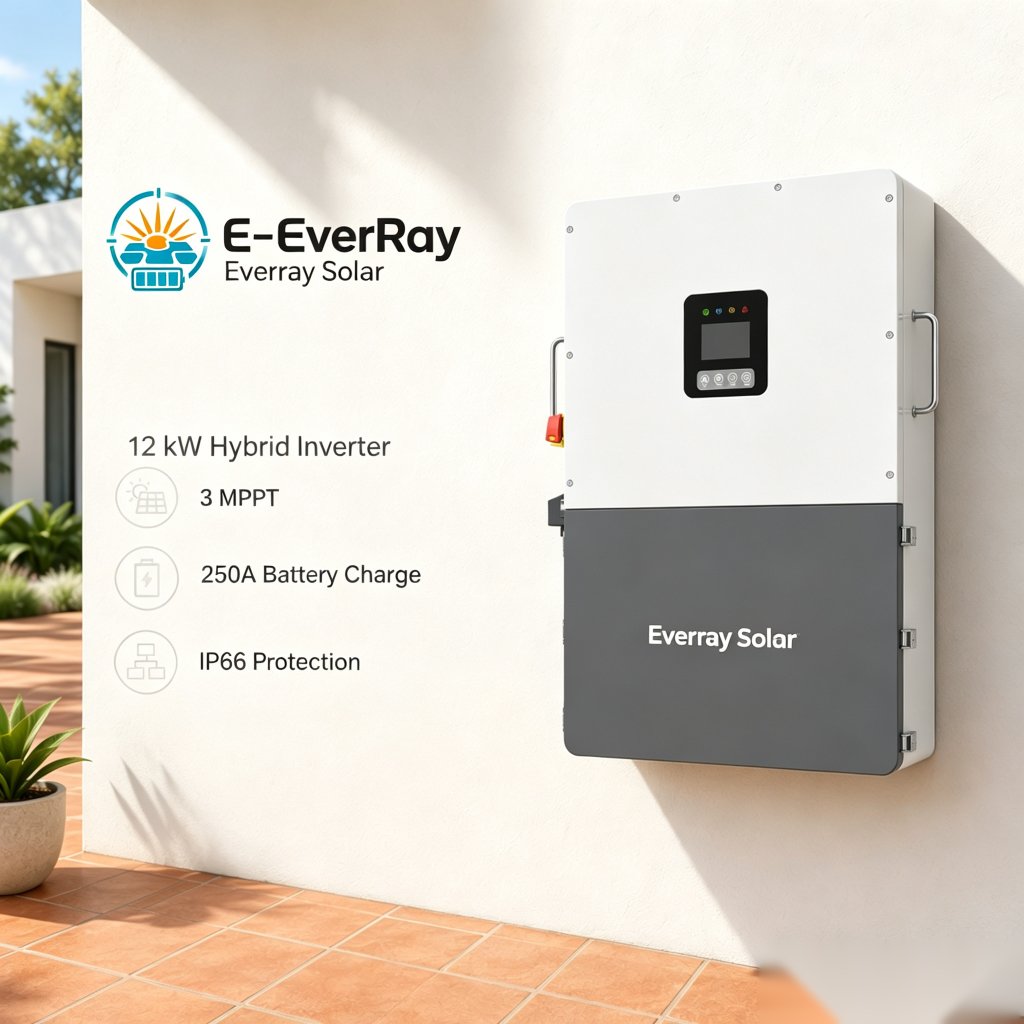
| EVR-H12K | 12 kW / 51.2 V | 51.2 V LiFePO4, 250 A charge | 3 MPPT (150–450 V PV), parallel up to 6 units, 45 kg | IP66 |
| EVR-H15K | 15 kW / 51.2 V | 51.2 V LiFePO4, 275 A charge | 3 MPPT, parallel up to 6 units, 50 kg | NEMA 4X |
| EVR-H60K three-phase | 60 kW | High-voltage LiFePO4, 64 A charge | 6 MPPT, 384–800 V PV, parallel up to 8 units (480 kW), generator input, up to 95% efficiency | C&I |
The global 2–12 kW series remains the workhorse for off-grid homes, shops and farms across Africa, the Middle East and Southeast Asia, with 12 V, 24 V and 48 V battery support. Certifications include FCC, IEC and UL marks on the Americas series (model dependent) — documentation available on request.
Five Sizing Mistakes That Cost Buyers Money
- Sizing from the panel array instead of the loads. A 5 kW roof does not mean a 5 kW inverter if your evening peak is 7 kW.
- Ignoring surge. Pumps and AC compressors need 2–5× their running power for a second or two — the most common cause of “my inverter keeps tripping”.
- Mixing battery voltage platforms. A 51.2 V inverter will not charge a 25.6 V bank; match platforms exactly.
- Underestimating charge current. A large bank on a small charger is never full by the evening peak — check the amp rating against your refill window.
- Forgetting the grid standard. Single-phase, split-phase and three-phase models are not interchangeable, and returns are expensive across borders.
Frequently Asked Questions
Can I oversize my solar array beyond the inverter rating?
Yes — a DC/AC ratio around 1.2 is standard practice and improves daily yield. Stay within the model’s maximum PV input voltage and current, which are separate limits from the AC rating.
What happens if my loads exceed the inverter rating?
Brief surges within the unit’s surge specification are tolerated. A sustained overload trips the overload protection and the inverter shuts down until loads are reduced. If this happens regularly, move non-essential loads off backup or step up a size.
Can one inverter sell solar to the grid and also back up my home?
Yes — that is exactly what “hybrid” means: grid interaction where regulations allow, plus automatic backup switching during outages. Your local net-metering rules decide how much excess you can export and at what rate.
How complicated is installation?
A typical home installation takes one to two days: mount the inverter on a wall, connect the PV strings, the battery bank and the AC circuits. All EverRay models ship with manuals, and our engineers support your installer during commissioning.
Do you provide sizing and system design?
Yes — free of charge. Send your load list, monthly consumption and grid standard, and our engineers reply within 24 hours with a matched inverter, battery and array specification, plus a quotation.
Get a Quote for Your Solar Project
Tell us your destination market and requirement. We reply within 24 hours on business days with specifications, certificates and pricing — no obligation.
Get the 2026 EverRay Product Catalogue
25 pages · solar modules 440-730W, hybrid inverters 2-150kW, LiFePO4 batteries, home & C&I energy storage, solar pumps, lighting and PV cleaning