Choosing a solar battery is where most off-grid and hybrid projects are won or lost. Panels are simple — buy watts, get watts. Batteries are not: two packs with identical capacity labels can differ threefold in usable energy, cycle life and true cost per kilowatt-hour delivered. This guide walks through the eight decisions that actually determine whether a battery bank lasts three years or fifteen, using the same method our engineers apply to customer projects.
The short version: match the chemistry to the duty cycle, the voltage platform to your inverter, and the capacity to your real overnight consumption — then verify the BMS and the certification before you sign anything. Everything below explains how to do each of those with numbers, not marketing claims.
Step 1: Start with the Chemistry — LiFePO4 vs Lead-Acid vs NMC
The chemistry decision drives everything downstream: lifespan, safety, weight, usable capacity and price per delivered kWh.
| Parameter | LiFePO4 (LFP) | Lead-Acid (AGM/Gel) | NMC Lithium |
|---|---|---|---|
| Cycle life at 80% DoD | 6,000+ cycles | ~500 cycles | 1,500–2,500 cycles |
| Usable depth of discharge | 80–90% | 50% (below that, life collapses) | 80–90% |
| Weight per kWh | ~8–10 kg | ~25–30 kg | ~6–8 kg |
| Thermal stability | Excellent — no thermal runaway under abuse | Good, but gassing and corrosion | Requires careful thermal management |
| Maintenance | None | Watering, equalisation charging | None |
| Self-discharge / month | 1–3% | 5–15% | 2–5% |
The practical consequence of that table is larger than most buyers expect. A 100 Ah lead-acid pack gives you roughly 50 Ah of usable energy before you start damaging it. The same nominal capacity in LiFePO4 gives you 80–90 Ah usable — and does it six thousand times instead of five hundred. Once you divide price by total lifetime kWh delivered, LiFePO4 is not a premium product. It is the cheaper one.
For stationary solar storage, LiFePO4 is the correct default. Choose NMC only where weight is the dominant constraint and the installation has proper thermal management; choose lead-acid only for very low-budget, low-cycle applications.
Step 2: Pick the Voltage Platform to Match Your Inverter
Battery voltage is not a free choice — your inverter constrains it. Getting this wrong means either a non-functional system or an expensive DC-DC converter you did not budget for.
| Platform | Typical Use | Form Factor |
|---|---|---|
| 12.8 V (4S) | RV, marine, small off-grid systems, solar lighting | Portable / small rack |
| 25.6 V (8S) | Medium off-grid systems, small shops and clinics | Wall-mounted / rack |
| 51.2 V (16S) | Home energy storage, hybrid inverter systems | Wall-mounted / stackable |
As a rule of thumb: below about 3 kW of inverter power, 12.8 V and 25.6 V platforms are practical. Above that, go to 51.2 V — higher voltage means lower current for the same power, which means thinner cables, less resistive loss and less heat in the DC path. A 5 kW load at 12.8 V draws roughly 390 A; the same load at 51.2 V draws under 100 A. That difference shows up in cable cost, terminal heating and system reliability.
Confirm two things in your inverter datasheet before ordering: the nominal DC input voltage range, and whether the inverter communicates with the battery BMS over CAN or RS485. A battery that cannot talk to the inverter will still work, but you lose state-of-charge reporting and coordinated protection.
Step 3: Calculate the Capacity You Actually Need
Do not start from the battery. Start from the load, and work backwards. The sequence is fixed:
- List your overnight loads in kWh. Take each appliance, multiply its power by the hours it runs after sunset, and add them up. A fridge cycling 8 hours at 150 W average is 1.2 kWh; lighting, internet, TV and a pump might add another 2 kWh.
- Add a backup reserve if you want the system to ride through outages — commonly 1 extra day of essential loads, not one extra day of everything.
- Divide by usable depth of discharge. For LiFePO4, use 0.8; for lead-acid, use 0.5.
- Divide by system efficiency. Round-trip losses through the inverter, cabling and battery internal resistance typically consume 10–15%, so divide by 0.88.
A worked example: 3.2 kWh overnight load, plus 1 day of 2 kWh essential backup, gives 5.2 kWh required. Divided by 0.8 usable DoD and 0.88 efficiency, the bank must be about 7.4 kWh nominal. That is the honest number — and it is why a “5 kWh” battery rarely covers a household that assumed 5 kWh would be enough.
Step 4: Decide Between Wall-Mounted, Rack and Stackable
Form factor is a site question, not a performance question — but choosing badly creates installation costs that dwarf any price difference between models.
- Wall-mounted — the default for residential retrofits. Keeps floor space clear, simplifies cable routing, and pairs naturally with a wall-mounted hybrid inverter. Verify the wall is load-bearing and that the unit is not mounted in direct sun.
- 19-inch rack — the professional choice for installers and small commercial rooms. Standard rack width means easy service access, straightforward replacement of a single module, and clean cable management. Slightly less attractive for a living space.
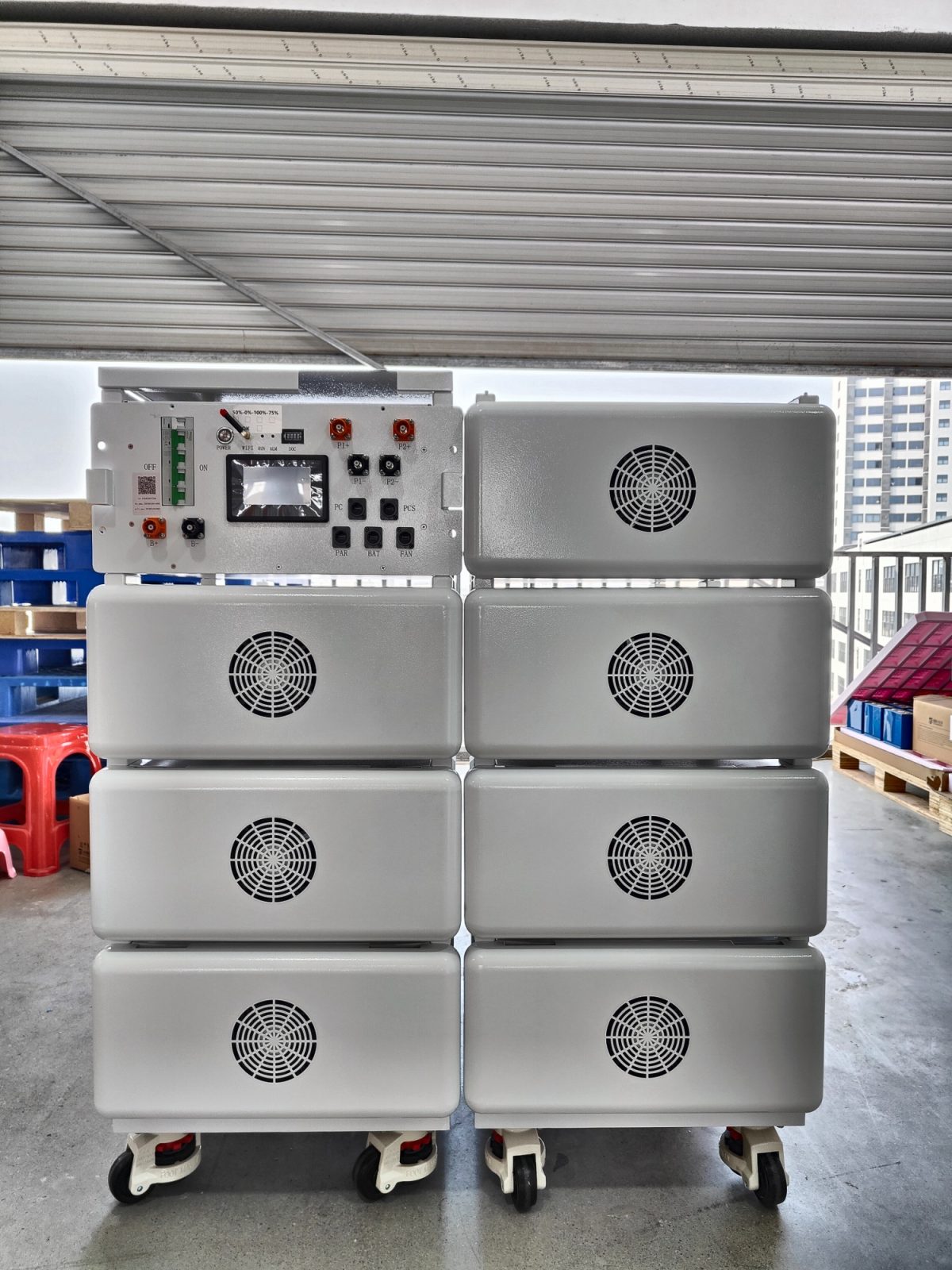
- Stackable modules — the most flexible option. Start with 3 kWh, add modules as the household grows or as budget allows. Each module should be independently fused and monitored so one failure does not take the bank down.
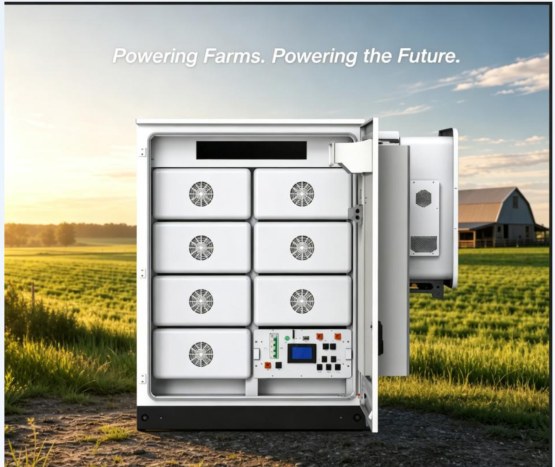
- All-in-one cabinet — battery, inverter and often the EMS inside one enclosure. Fastest to install and easiest to certify as a single unit; best for villas and small commercial sites where floor space and installation labour matter more than granular upgradeability.
Step 5: Read the BMS Specification, Not Just the Cell Spec
The BMS — battery management system — is what actually keeps a lithium bank alive. Two batteries using the same Grade-A cells can have very different field reliability based purely on BMS quality. Check that it provides:
- Cell balancing — passive or active, but present. Without balancing, the weakest cell drifts and drags the whole bank’s usable capacity down.
- Over-charge and over-discharge protection — hard cut-offs, not just alarms, with sensible recovery thresholds.
- Temperature protection — charge inhibition below freezing. Charging LiFePO4 below 0 °C causes permanent lithium plating; this protection is mandatory, not optional.
- Short-circuit and over-current protection — with a breaking capacity appropriate to the bank’s fault current.
- Communication output — CAN or RS485 with a documented protocol. Ask for the protocol document. If the supplier cannot provide one, the battery will not integrate cleanly with mainstream inverters.
A useful test when evaluating suppliers: request the BMS parameter sheet alongside the cell datasheet. A supplier who can only show cell brochures is reselling, not engineering.
Step 6: Verify Certification and Shipping Documentation
Lithium batteries are regulated dangerous goods. Incomplete documentation stops shipments at the port and can invalidate your insurance.
- UN38.3 — mandatory test report for lithium battery transport, covering altitude, thermal, vibration, shock, external short circuit, impact and overcharge.
- MSDS — material safety data sheet, required by carriers and customs.
- IEC 62619 — the safety standard for industrial and stationary lithium cells and batteries.
- UL 9540 / UL 9540A — the North American standard for energy storage systems, with 9540A covering thermal runaway propagation. Increasingly requested for C&I projects and in some jurisdictions required outright — see how we apply it across our 100-500kWh commercial and industrial energy storage cabinets.
- CE — for European market access, with the relevant EMC and safety directives.
Ask for the certificates with the battery model number visible. A generic certificate for a different model is not proof of anything.
Step 7: Evaluate the Real Cost — Price per Delivered kWh
Comparing upfront prices between a lead-acid pack and a LiFePO4 pack is the classic purchasing error. The meaningful metric is cost per kilowatt-hour actually delivered over the life of the bank:
Cost per delivered kWh = Purchase price ÷ (Nominal capacity × Usable DoD × Cycle life)
Run that on a typical comparison and the ranking inverts. A cheap lead-acid bank with 500 cycles and 50% DoD delivers perhaps a quarter of the lifetime energy of a LiFePO4 bank, so it must cost less than a quarter as much to be competitive — which it almost never does once you include replacement labour and the two extra replacement cycles within a decade.
Also factor in what a longer-life battery is worth in customer trust. For an installer, a bank that outlives its warranty means no return visits; a bank that fails at year four means an unpaid service call and a damaged reputation.
Step 8: Match the Battery to the Whole System
A battery is one component of a chain: array, MPPT, inverter, battery, loads. Every link constrains the others.
- Charge current must be within the battery’s acceptance limit. An oversized array without a charge-current limit will trip BMS protection on a clear day and waste the best solar hours.
- Discharge current must cover your peak load — not your average load. Check the continuous discharge rating against the surge draw of motors, pumps and compressors.
- Inverter low-voltage cut-off must align with the BMS cut-off. If the inverter keeps demanding power after the BMS has disconnected, you get nuisance trips and confusing fault codes.
- Temperature environment matters. LiFePO4 performs best between roughly 15 °C and 35 °C. A battery installed in an unconditioned shed in a hot climate will not achieve its rated cycle life.
This is the argument for sourcing the full system from one supplier. When modules, inverter and battery are specified and tested together, the interfaces are already solved — and responsibility for any mismatch stays in one place instead of being split between three vendors who each point at the other two.
Frequently Asked Questions
How long will a LiFePO4 solar battery actually last?
A quality LiFePO4 bank rated at 6,000+ cycles at 80% depth of discharge is typically expected to run 10 to 15 years in daily-cycling residential service, and longer in backup-only applications where it rarely cycles. Real life depends on temperature, depth of discharge and whether the BMS is doing its job. Extremes of heat and repeated deep discharge at high current are the two factors that shorten life fastest.
Can I mix batteries of different ages or capacities?
Not in parallel without care. Batteries of different age or internal resistance will share current unevenly, and the weaker unit will be worked harder and fail sooner. If you must expand, add identical modules from the same production batch where possible, and confirm the BMS supports parallel coordination. This is a strong argument for choosing a stackable platform designed for expansion from the start.
Is 12.8 V or 51.2 V better for a home system?
51.2 V for anything above roughly 3 kW, which covers most home storage. Higher voltage reduces current, cable size and resistive losses, and most residential hybrid inverters are designed around a 48–51.2 V nominal DC bus. The 12.8 V platform is better suited to RVs, boats and small standalone systems.
Do I need a battery for a grid-tied solar system?
Not for basic self-consumption — a grid-tied system without storage simply exports surplus and imports at night. A battery becomes worthwhile when you face high evening tariffs, frequent grid outages, or low feed-in rates that make export uneconomic. In those cases, storage converts an export at a low rate into a avoided import at a high rate.
What certifications should I insist on?
At minimum: UN38.3 transport test report, MSDS, and IEC 62619 for stationary industrial application. For North American projects add UL 9540, and for European projects confirm CE marking with the applicable directives. Always request certificates bearing the exact model number you are buying.
Get Your Battery Bank Sized in 24 Hours
Send us your overnight load in kWh, your inverter model and voltage platform, and your expected daily cycling pattern. Our engineers will specify the right capacity and configuration — and quote a matched kit with modules, inverter and battery tested together as one system rather than a collection of parts.
We supply LiFePO4 batteries in 12.8 V, 25.6 V and 51.2 V platforms, from wall-mounted and rack units to stackable home storage cabinets up to 60 kWh, all with Grade-A cells, smart BMS and full export documentation.
See our LiFePO4 battery range → | Browse home energy storage →
Get a Quote for Your Solar Project
Tell us your destination market and requirement. We reply within 24 hours on business days with specifications, certificates and pricing — no obligation.
Get the 2026 EverRay Product Catalogue
25 pages · solar modules 440-730W, hybrid inverters 2-150kW, LiFePO4 batteries, home & C&I energy storage, solar pumps, lighting and PV cleaning