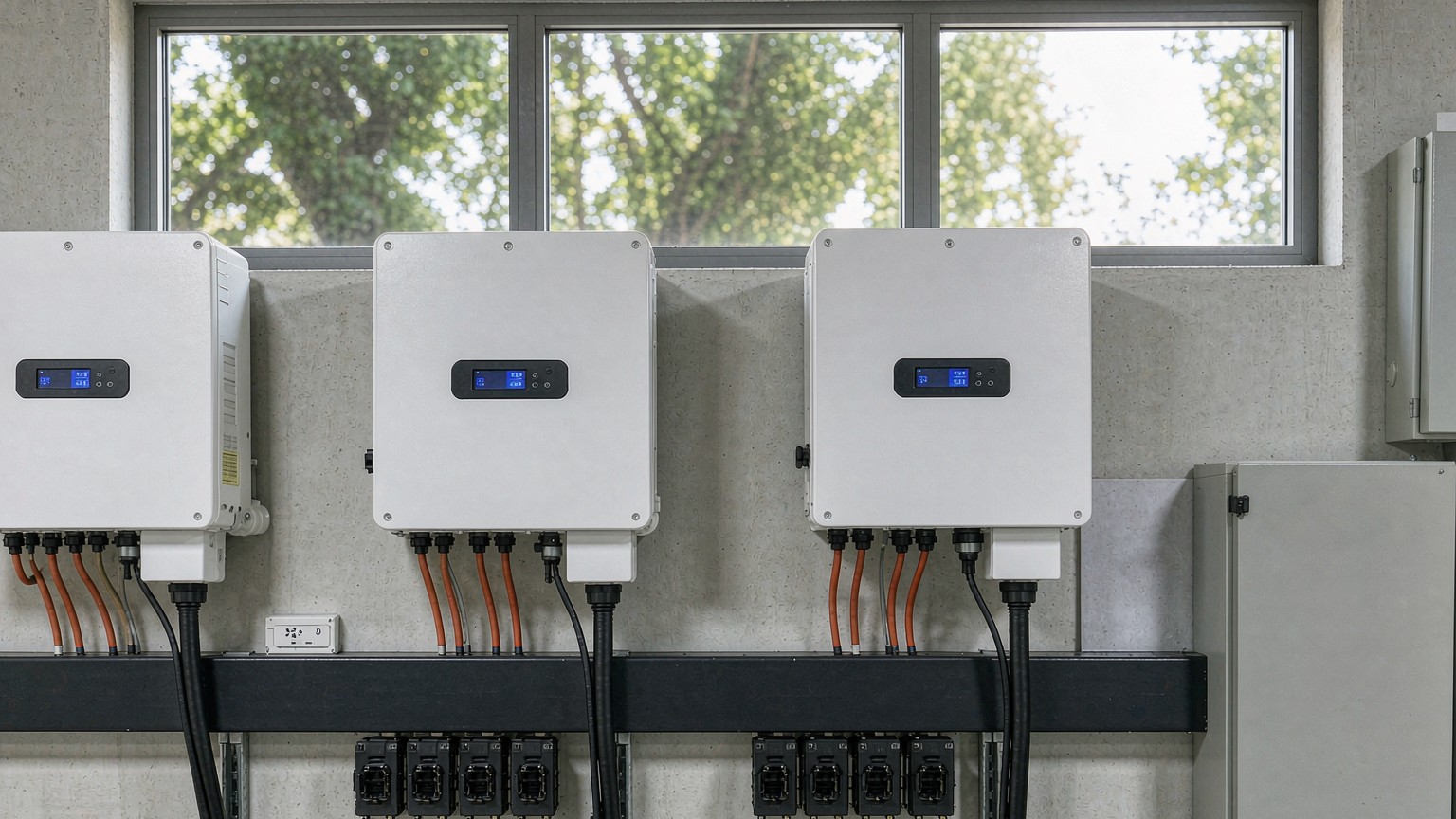
Every solar quotation eventually reaches the same fork: a straightforward string inverter that converts panel power into AC and stops there, or a hybrid inverter that also manages a battery, keeps selected loads alive during an outage, and decides every hour whether solar energy should be used, stored or exported. The price gap between the two can be significant, which makes this one of the few sizing decisions that can waste money in both directions — paying for capability you will never use, or boxing yourself out of storage you will soon want.
This guide compares hybrid inverter vs string inverter on the factors that actually move project economics: battery readiness, backup behaviour, efficiency, hardware cost and retrofit paths. No electrical engineering background is required — every term is explained where it first appears. It is the topology companion to our hybrid inverter sizing guide: that article covers what capacity to buy, this one covers which architecture to buy.
Hybrid Inverter vs String Inverter: The Short Answer
Choose a string inverter when the grid is reliable, exported energy earns a decent tariff, and no battery is planned — it is the cheapest and simplest way to turn sunlight into revenue. Choose a hybrid inverter when any of the following is true: a battery is in the plan now or realistically within the system’s life, backup power has real value, or self-consumption pays better than exporting. In markets with frequent outages — much of Africa, South Asia, Latin America and the Caribbean — the hybrid usually wins outright. In mature markets with stable grids and generous feed-in arrangements, the string inverter still earns its keep.
What a String Inverter Does
A string inverter is the classic grid-tied architecture. Series-connected strings of solar modules feed DC power into one or more MPPT trackers, the inverter converts it to grid-compatible AC, and everything generated is either consumed on site or exported to the grid. There is no battery port and no energy-management brain beyond basic export limiting. And when the grid fails, the inverter shuts down completely — anti-islanding protection is mandatory, because a line that crews are repairing must never be energised by a rooftop.
That simplicity is the product. One conversion stage, no battery electronics, fewer components to fail, and the lowest cost per installed watt of any inverter class. String inverters are the default on utility-scale plants, on commercial rooftops where outages are tolerable, and on any residential system whose value is purely the kilowatt-hours it produces.
What a Hybrid Inverter Adds
A hybrid inverter is a string inverter plus a bidirectional battery channel and a control layer that manages energy by the hour. Concretely, you get:
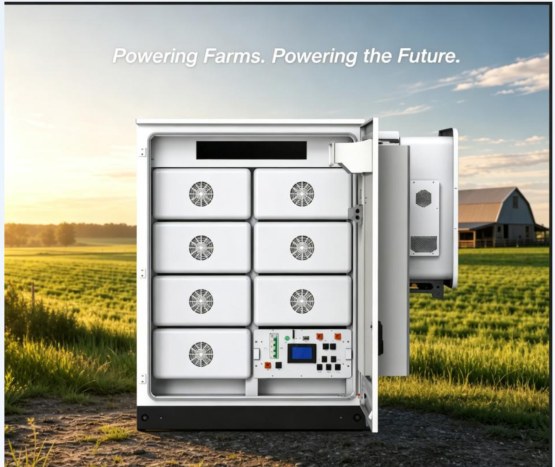
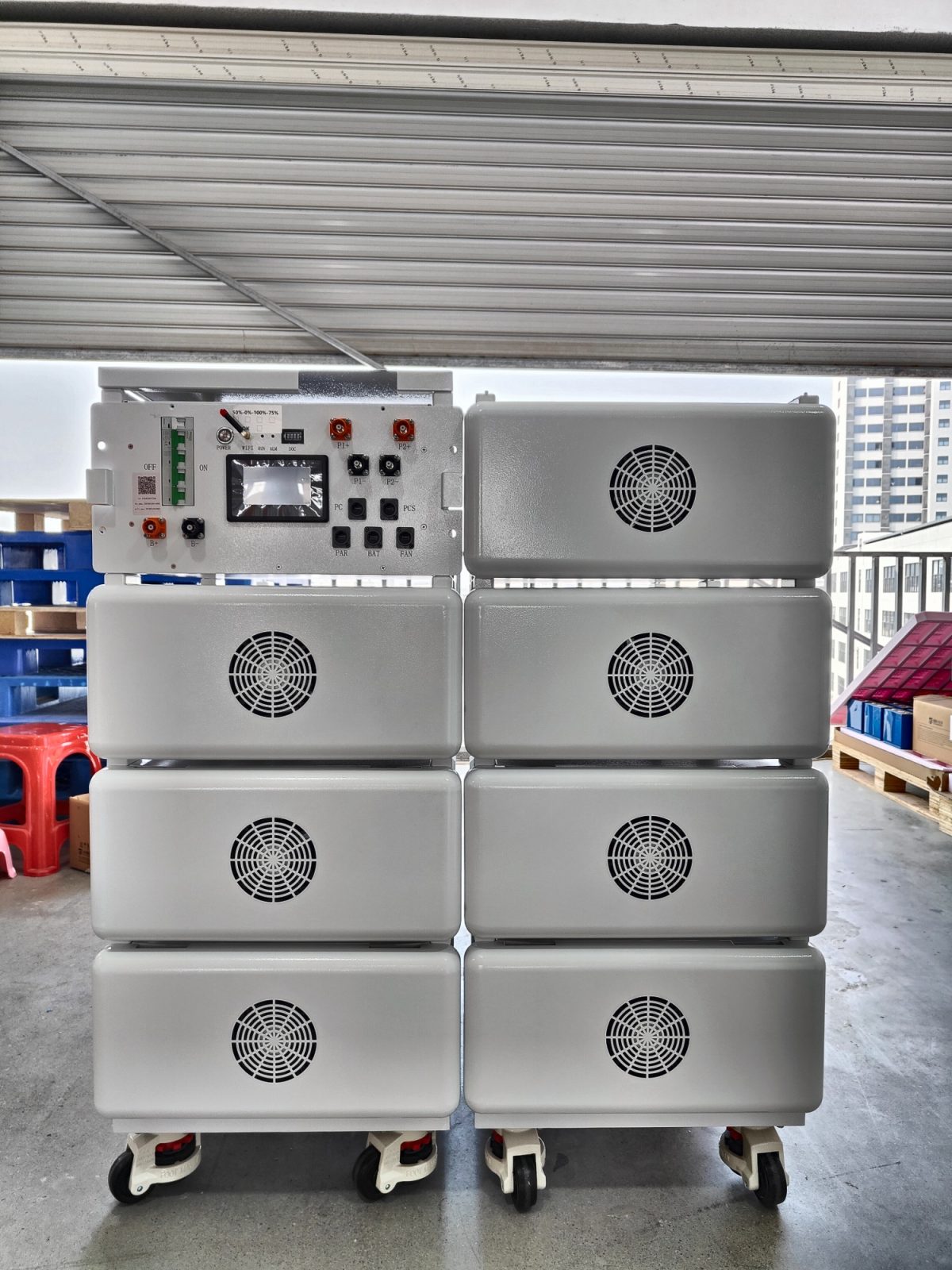
- A battery port (DC coupling) — the inverter charges and discharges a low-voltage battery bank (the 48 V / 51.2 V class) directly on the DC side, so panels, battery and loads live in one box.
- Backup output (EPS) — when the grid fails, the inverter disconnects from the network and powers dedicated backup circuits from battery and panels within milliseconds.
- Energy management — self-consumption priority, time-of-use scheduling (charge from cheap night tariffs or midday solar, discharge during expensive evening peaks) and programmable export limits.
- Parallel expansion — most models parallel several units to serve larger homes or small commercial loads; our split-phase models, for example, parallel up to six units.
- Generator input — on many models a genset can be connected for weak-grid or off-grid sites, with the inverter managing charge priority.
Because the battery hangs off the DC bus, energy moving from panels to battery is converted once instead of twice, which matters in systems that cycle daily. It also means one device to install, monitor and warranty instead of a separate battery inverter tacked on later.
One point worth repeating: a hybrid inverter with no battery connected behaves exactly like a grid-tie inverter. Batteries are an addition, not a prerequisite — which is precisely what makes the hybrid a future-proof purchase.
Hybrid Inverter vs String Inverter: Side by Side
| Aspect | String (grid-tie) inverter | Hybrid inverter |
|---|---|---|
| Battery connection | None — AC-coupled retrofit only | Built-in DC battery port |
| Power during an outage | Shuts down with the grid | Powers backup circuits from battery + solar (EPS) |
| Energy management | Basic; export limit at most | Self-consumption, time-of-use scheduling, load prioritisation |
| Conversion path | One stage: DC → AC | DC → AC, plus DC → battery and battery → AC as needed |
| Peak efficiency | ~98% (class benchmark) | Typically within half a point; battery round-trip adds its own losses |
| Hardware cost | Lowest per watt | Materially higher; the gap narrows at higher power classes |
| Adding storage later | Possible via AC-coupled kit, with compatibility limits | Native — add battery packs any time |
| Best suited to | Stable grids, export-driven economics, no-battery projects | Backup needs, high retail tariffs, outage-prone grids, storage roadmaps |
The Five Factors That Actually Decide the Choice
1. Batteries: now, later, or never
If the honest answer is “never”, buy a string inverter and spend the savings on more panels. If it is “probably within two or three years”, buy the hybrid now: the premium at purchase time is smaller than the cost of replacing a working string inverter or bolting an AC-coupled system onto it later. Our home energy storage guide walks through how battery capacity decisions interact with inverter choice.
2. How often the grid fails
Outage frequency is the single most emotional and most financial factor. Three outages a year of two hours each may be an inconvenience; daily load-shedding of four hours makes a string-only system practically useless for evening demand. A hybrid’s EPS output turns solar into genuine energy independence — and in many of our export markets, that independence is the entire reason the customer is buying.
3. How your generated power gets paid
Where net metering or feed-in tariffs are generous, every exported kilowatt-hour is revenue and a string inverter monetises panels directly. Where exported power earns little or nothing — common in markets with weak regulatory frameworks — the winning strategy is self-consumption: use your own solar, store the surplus, export almost nothing. Self-consumption economics require storage, and storage on the DC side requires a hybrid.
4. System size, phase and voltage
Single-phase homes up to roughly 6 kW can go either way. North and Latin American homes run on 120/240 V split-phase, which narrows the field to inverters built for that topology. Small commercial systems on three-phase supplies in the 30–60 kW range are well served by hybrid units in parallel or three-phase hybrid models. Utility-scale plants stay string-and-central: no battery management layer is needed, and efficiency fractions compound over megawatts.
5. New installation or retrofit
On a new build, choosing hybrid costs little extra and keeps every option open. On a retrofit — adding storage to an existing string-inverter system — an AC-coupled battery is the usual answer, and it works, but check compatibility list by list: not every AC-coupled battery cooperates with every string inverter, and each extra conversion stage adds loss. Sometimes the cleanest retrofit is replacing the string unit with a hybrid and DC-coupling from day one.
When a String Inverter Is Still the Right Choice
- The grid is dependable and outages, when they happen, are short and tolerable.
- Export tariffs or net metering make every generated kilowatt-hour worth selling.
- The budget is fixed and every dollar moved to the inverter is a dollar not spent on panels.
- The system is large (commercial or utility) and battery operation was never in scope.
When a Hybrid Inverter Pays for Itself
- Outages are frequent enough that backup power has daily or weekly value.
- Retail electricity is expensive relative to export tariffs — the classic self-consumption case.
- Time-of-use pricing exists: charge the battery when power is cheap, discharge when it is not.
- A battery is planned for the future, even if the budget only allows it next year or the year after.
- The site is weak-grid or off-grid and pairs with a generator.
What to Check Before You Commit to a Hybrid Inverter
Not all hybrids are equal, and the differences hide in specification lines. Before signing anything, confirm:
- Battery voltage family — 48 V and 51.2 V packs are not interchangeable; the inverter, the battery and the charge current must be designed for one another.
- MPPT count and PV voltage window — two or three trackers give design freedom on complex roofs; the window must accept your string voltages in both summer heat and winter cold.
- Backup (EPS) rating — the inverter’s nameplate rating and its backup output are not always the same number; size backup against the loads that genuinely matter during an outage (our sizing guide covers the arithmetic).
- Parallel capability — how many units, and what synchronises them, if you expect to grow the system.
- Certificates for the destination market — UL 1741 for North America, CE/IEC reports elsewhere; our CE vs UL vs IEC guide explains which paper proves what.
- Monitoring and communications — Wi-Fi or GSM dongle, local RS485, and an app your installer can actually configure remotely.
Where the EVR-H Series Fits
Our EVR-H hybrid inverter series spans 2–60 kW across single-phase, split-phase and three-phase topologies. For the Americas: the EVR-H10K and EVR-H16K (single-phase, 48 V, NEMA 4X outdoor enclosures) and the EVR-H12K and EVR-H15K (120/240 V split-phase, 51.2 V, three MPPTs, parallel up to six units) cover home-backup systems from essential loads to whole-house with air conditioning. On the three-phase side, EVR-H models up to 60 kW pair with high-voltage LiFePO4 racks for small commercial systems — the same blocks behind our C&I energy storage packages. Every model is supplied with matched LiFePO4 battery options so voltage, current and communication protocols are validated as one system before shipment.
Frequently Asked Questions
Can I add a battery to a string inverter later?
Yes, through an AC-coupled battery system, which connects on the AC side and works alongside the existing inverter. It functions, but expect an extra conversion stage, a compatibility check between brands, and two devices to monitor and warranty. If storage is likely, starting with a hybrid is usually cheaper and cleaner.
Is a hybrid inverter less efficient than a string inverter?
Peak AC efficiency is typically within half a percentage point — modern hybrids reach the high 97s and above. The honest comparison includes the battery’s round-trip efficiency (roughly 90–95% for LiFePO4), but that loss is the price of having stored energy at all, not a penalty of the hybrid topology.
Can a hybrid inverter work without batteries?
Yes. With no battery connected, a hybrid operates as a conventional grid-tied inverter. The battery port simply sits ready, which is why hybrid-first is a common strategy for buyers who want to phase their investment.
Can a hybrid inverter run a house off-grid permanently?
Many hybrid models are designed for weak-grid and off-grid sites, with generator input and full battery-priority operation — our split-phase units are built for exactly these deployments. Off-grid design changes the sizing maths substantially (autonomy days, generator integration), so confirm backup and generator behaviour for the specific model before committing.
Which costs less over ten years: hybrid or string?
It depends entirely on your tariffs and outage reality. With reliable grids and good export tariffs, string wins on pure cost. With expensive retail power, poor export terms or frequent outages, the hybrid’s storage capability usually repays its premium well inside a decade — and it avoids the retrofit cost of adding storage to a string system later.
Get a Hybrid or String Inverter Quote
Tell us your market, your load profile and whether backup matters, and we will recommend the honest answer — including the cases where a string inverter is genuinely the better buy. Browse the EVR-H hybrid inverter series for specifications, or send us your requirements and we will respond within 24 hours.
Get a Quote for Your Solar Project
Tell us your destination market and requirement. We reply within 24 hours on business days with specifications, certificates and pricing — no obligation.
Get the 2026 EverRay Product Catalogue
25 pages · solar modules 440-730W, hybrid inverters 2-150kW, LiFePO4 batteries, home & C&I energy storage, solar pumps, lighting and PV cleaning