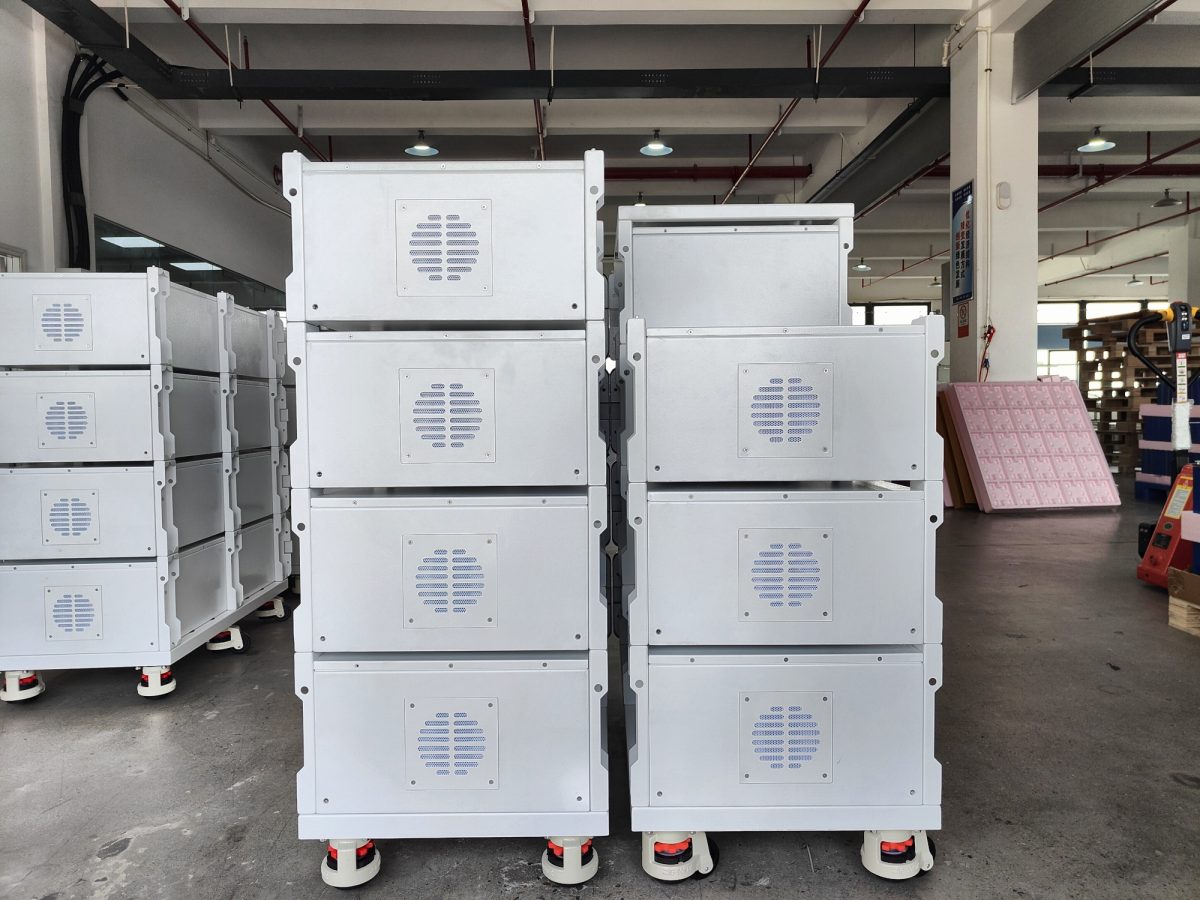
From 18 February 2027, every LMT battery, every industrial battery above 2 kWh and every EV battery placed on the EU market must carry a digital battery passport — a QR-linked, machine-readable data record with roughly 90 mandatory attributes. No passport, no market access, and the unique identifier is checked at the EU customs border. For a solar distributor importing 100 kWh rack batteries or 215 kWh cabinets from China, the passport is not an environmental slogan: it is an import licence in data form.
This guide sets out what the passport must contain, who is legally responsible when the manufacturer sits in China, what is already fixed in law versus what is still waiting on delegated acts, and the eight questions to put to any supplier before you place a 2027-bound order.
What the battery passport is — and what it is not
The passport is defined in Article 77 of Regulation (EU) 2023/1542. It applies to exactly three categories placed on the market or put into service from 18 February 2027:
- batteries for light means of transport (LMT);
- industrial batteries with a capacity greater than 2 kWh;
- electric vehicle batteries.
Two boundaries matter for solar buyers. First, portable and consumer batteries are outside the passport — a 12.8V 100Ah leisure battery sold to a consumer may avoid it, but the moment the same lithium pack is classified as industrial above 2 kWh, it is in scope. A 16 kWh home-storage rack is unambiguously in scope. Second, do not confuse the passport with the QR code: under Article 13, all batteries carry a QR code from the same date, but the QR code is only the entry point. The passport is the data system behind it, hosted by an operator, updated through the battery’s life, and readable at four permission levels — public, restricted (repairers, remanufacturers, recyclers), and authorised (market surveillance authorities and the Commission).
The dates that matter
| Date | What starts | Who it hits first |
|---|---|---|
| 18 Feb 2025 | Carbon footprint declaration — EV batteries (delegated act dependent) | EV supply chains |
| 18 Feb 2026 | Carbon footprint declaration — rechargeable industrial batteries >2 kWh | C&I storage, rack batteries |
| 18 Feb 2027 | Battery passport mandatory (Art. 77) + QR code on all batteries (Art. 13) | LMT, industrial >2 kWh, EV |
| 18 Aug 2027 | Supply-chain due diligence obligations (postponed from Aug 2025) + recycled content declaration | All large batteries and their importers |
| 18 Aug 2028 | Carbon footprint maximum thresholds begin phasing in | Whole EU market |
| 2031 | Recycled content minimums: cobalt 16%, lithium 6%, nickel 6%, lead 85% | Whole EU market |
One warning about the calendar: several of the detailed data formats are still being settled through delegated and implementing acts. The obligation date is fixed; some field-level formats are not. That is not a reason to wait — it is a reason to build the data collection chain now, because the chain takes longer to assemble than the format.
What is inside the passport
The Commission’s digital battery passport guidance organises the attributes into a grid of roughly 71 data points, which expand to around 90 mandatory attributes once per-chemistry variations are counted. The core blocks:
- Identity and traceability — manufacturer, manufacturing place, battery category, model, chemistry, unique product identifier linked to the QR code;
- Carbon footprint — the declared value calculated under the delegated methodology, with the class threshold tightening from 2028;
- Materials — critical raw materials, and from 2031 the recycled shares of cobalt, lithium, nickel and lead;
- Performance and durability — rated capacity, power, round-trip efficiency where applicable, expected lifetime;
- State of health — dynamic data updated as the battery operates, which is what makes the passport a living record rather than a PDF;
- Due diligence — supply-chain policy and risk reports for tin, tungsten, tantalum, cobalt and graphite chains.
The data must follow open standards, be interoperable, machine-readable, structured and searchable — a scanned certificate folder on a shared drive does not qualify.
Who is responsible when the factory is in China
For an imported battery, the economic operator placing the battery on the EU market carries the obligation. If you import under your own name, that is you — not the Chinese manufacturer, and not the freight forwarder. In practice the responsibilities split like this:
- The manufacturer (or its EU authorised representative) supplies the underlying data: chemistry, cell provenance, carbon footprint inputs, performance test results.
- The importer verifies the passport exists and is accurate before placing the battery on the market, keeps the unique identifier available, and answers to market surveillance.
- The passport operator hosts the record. Every passport needs one; operator capacity is an industry-wide bottleneck in the run-up to February 2027.
- Customs verifies the unique registered identifier at the border. A consignment without a resolvable identifier is a blocked consignment.
The eight questions to ask a Chinese supplier now
- Who generates the cell-level data? The passport needs provenance down to cell level. If your supplier is an assembler, ask which cell maker’s data chain they sit on and whether that chain can export structured data, not marketing PDFs.
- Which carbon footprint methodology will the declaration use? Ask for the draft declaration, not a promise. The industrial-battery declaration obligation is already live from February 2026.
- Can they evidence recycled content shares? Even before 2031 minimums, the declaration lands in August 2027.
- Which passport operator are they integrating with? If the answer is “we will handle it later”, treat the 2027 order as at-risk.
- Is the data model interoperable? Open standards, machine-readable, structured — ask for a sample export in a standard format.
- Who updates state-of-health data during life? The passport must track the battery, so someone must own the update duty across the warranty period.
- What is the plan for the QR code and unique identifier? Who prints it, who registers it, who guarantees resolution at customs.
- What happens if delegated acts shift field formats after your order is placed? A supplier with a live data chain adapts; one without it will renegotiate or go quiet.
Battery passport vs UN38.3: two different tracks, both mandatory
Buyers mix these up constantly, so here is the clean split:
| UN38.3 + shipping docs | Battery passport | |
|---|---|---|
| Governs | Transport safety | Market access and lifecycle transparency |
| Applies | Every lithium shipment, worldwide, now | EU market, three categories, from 18 Feb 2027 |
| Documents | UN38.3 test summary, MSDS, Class 9 label, packing cert | ~90 digital attributes behind a QR code |
| Checked by | Airlines, shipping lines, port authorities | EU customs and market surveillance |
| Our guide | UN38.3, MSDS and Class 9 shipping guide | This page |
You need both. UN38.3 gets the container on the vessel; the passport gets it off the quay in Europe.
How EverRay handles passport data
Every EverRay storage battery and cabinet shipped to the EU from 2026 onward comes with a data dossier per consignment: cell provenance records, the carbon footprint declaration inputs, performance and durability test results, and the identifiers needed to register the passport with your chosen operator. Because we assemble from an audited multi-plant supply chain, we orchestrate the cell-level data chain for you instead of leaving you to chase a cell factory in another language and time zone.
We will not pretend the industry is ready: operator capacity, delegated-act formats and NB auditing slots are genuine bottlenecks for everybody, including the tier-one brands. What separates a workable supplier from a risky one is whether the data chain exists today. Ask the eight questions above; our answers are yes, documented, and available before you transfer any deposit.
If you are building EU-bound orders for 2027, start with the numbers on our solar battery wholesale price page, read the full obligations timeline in our EU Battery Regulation 2023/1542 importer guide, then send us your 2027 volume plan through the form below — we will reply with the passport data availability for the exact models, not a brochure.
Get a Quote for Your Solar Project
Tell us your destination market and requirement. We reply within 24 hours on business days with specifications, certificates and pricing — no obligation.
Get the 2026 EverRay Product Catalogue
25 pages · solar modules 440-735W, hybrid inverters 2-150kW, LiFePO4 batteries, home & C&I energy storage, solar pumps, lighting and PV cleaning