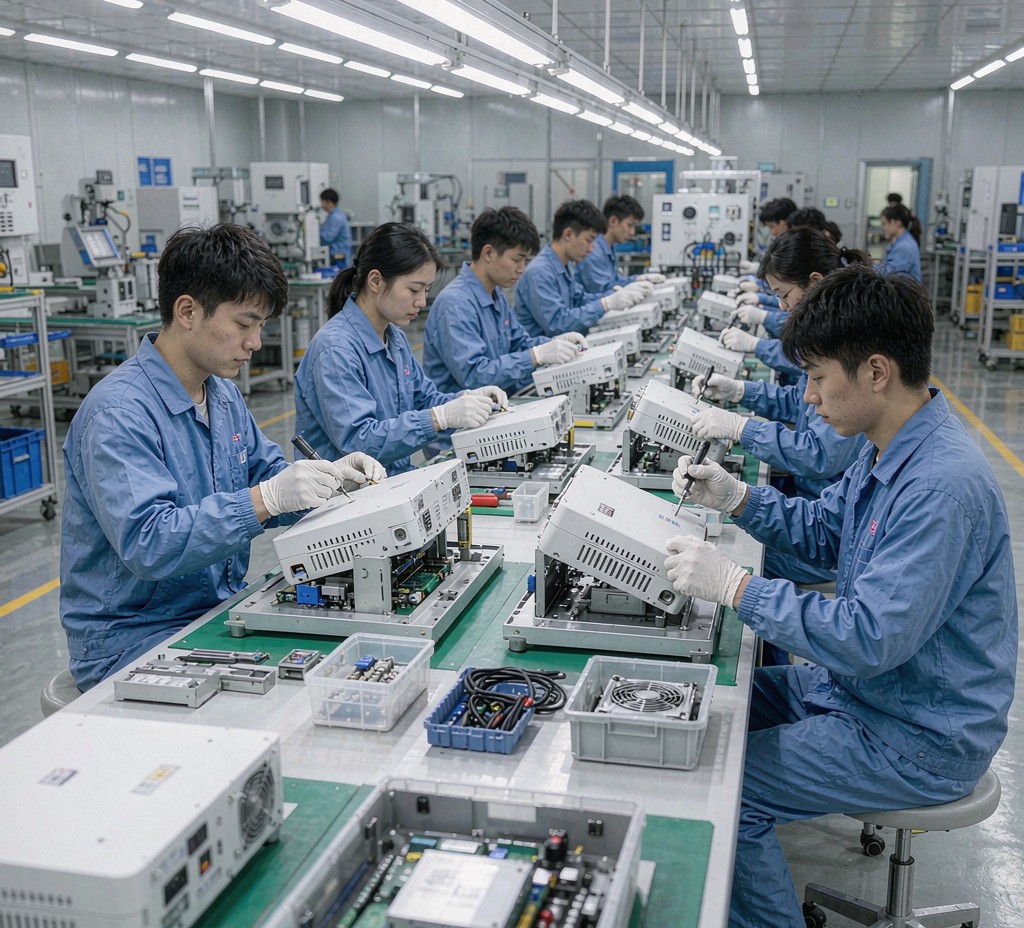
Most solar factory audits are theatre. The buyer is collected from the airport, walked through a spotless showroom, photographed next to a laminator, handed a USB stick of brochures and sent home convinced. Nothing in that visit proved the plant can build the order, or that the company taking the deposit is the company that owns the line.
The difference between an audit and a factory tour is not how long you stay. It is whether you ask questions that have verifiable answers — documents you can read, records you can pull, serial numbers you can trace while you are still standing there. The twenty questions below are grouped into six blocks. For each one, a genuine plant answers in under a minute and reaches for a document; a trading office answers in paragraphs and reaches for a colleague.
What a factory audit can and cannot prove
An audit is good at four things: confirming the legal entity, confirming which processes actually run under that roof, doing the capacity arithmetic, and testing whether a quality system exists as records rather than as a certificate on the wall.
It cannot tell you whether this shipment will be good, whether the company will still be solvent in two years, or whether your container will be prioritised when a bigger customer calls. Those need a pre-shipment inspection with your own or a third-party inspector, a trial order small enough to lose, and contract terms that cost the supplier money when they miss. Audit first, then inspect, then scale.
Block 1 — Identity and legal standing (Q1–Q4)
1. Which legal entity will issue the proforma invoice, and is it the same entity on the business license? Ask for the license scan, the export registration and the bank account beneficiary. All three should match character for character. When the salesperson explains that the account belongs to “a sister company” or “our Hong Kong office” without an authorization letter, you are not talking to the manufacturer.
2. Do you own the building, or do you lease it? Ask for the property certificate or the lease, and look at the remaining term. Five years left on a lease is fine; eighteen months is a delivery risk you are underwriting. A plant that can produce neither document is usually renting a floor inside somebody else’s factory — which can still be a legitimate supplier, but it is not the entity you thought you were auditing.
3. Does the registered business scope include manufacturing? Read the license rather than the brochure. Chinese licenses state the scope explicitly: production and manufacturing of solar modules or power electronic equipment reads differently from sales, import and export, or commission agency. A scope that lists only trading activities is the single fastest way to identify a middleman.
4. Who is the person answering my WhatsApp, and who do they work for? If your contact sits in a separate trading arm, ask for the authorization letter that lets that company sell on behalf of the plant, with a named signatory and a validity date. This one document decides whether your warranty claim in year three will be honoured or forwarded around a group chat.
Block 2 — Production (Q5–Q8)
5. How many production lines, and what is the rated capacity of each? For modules, one stringer-plus-laminator line runs roughly 100–150 MW a year on a single shift, depending on cell format. Do the multiplication in front of them. A supplier claiming 5 GW from four lines is quoting a brochure, not a factory.
6. Which models are running on the line this week? Ask to see the production schedule or the work order on the line. “We can make anything” is the answer of a broker; a plant knows exactly what is on the line on Thursday and which customer it belongs to.
7. How many shifts do you run, and what is your current utilisation? One shift at 60% means your order can start next week. Three shifts at 95% means your February order ships in April, whatever the quotation says. Utilisation also tells you whether the price you were given is a real price or a number invented to win the enquiry.
8. Which steps happen under this roof, and which are outsourced? Walk the route: stringer, layup, lamination, framing, junction box, curing, EL, flash test, packing. Ask them to mark each one in-house or outsourced, and to explain how that partner is qualified and audited. Outsourced lamination is where cosmetic defects, delamination and PID failures come from, and it is the first thing a supplier hides.
Block 3 — Components and traceability (Q9–Q12)
9. Which cell supplier, which grade, and can I see the purchase record for the batch? A-grade, B-grade and “mixed” are commercial categories with real price differences. Ask for the cell invoice or the incoming inspection record for the batch that will be used on your order — not a sample datasheet from the cell maker.
10. Can you trace this serial number back to its cell batch, laminate shift and flash-test data? Pick a finished unit from the warehouse at random, write down its serial, and ask them to do it in front of you. A real plant does it in minutes. An assembler asks you to come back tomorrow, then emails a file with no timestamps.
11. What is your BOM change notification policy, in writing? Any change of cell supplier, encapsulant, junction box, diode or BMS can invalidate the test report the certificate was based on. Ask for a clause committing to 30 days’ written notice and re-certification before shipment. A supplier who will not sign that clause will change something quietly in month four.
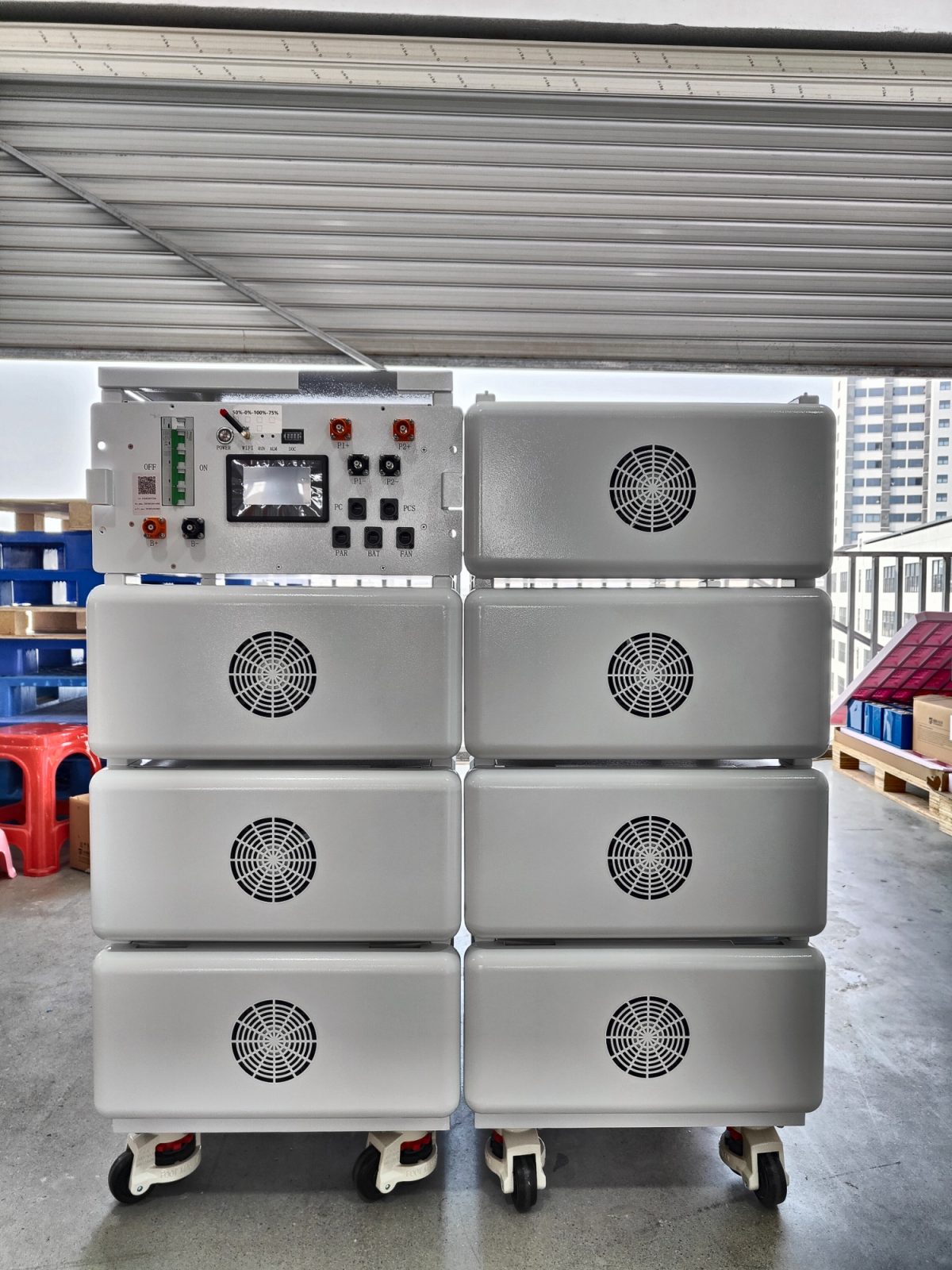
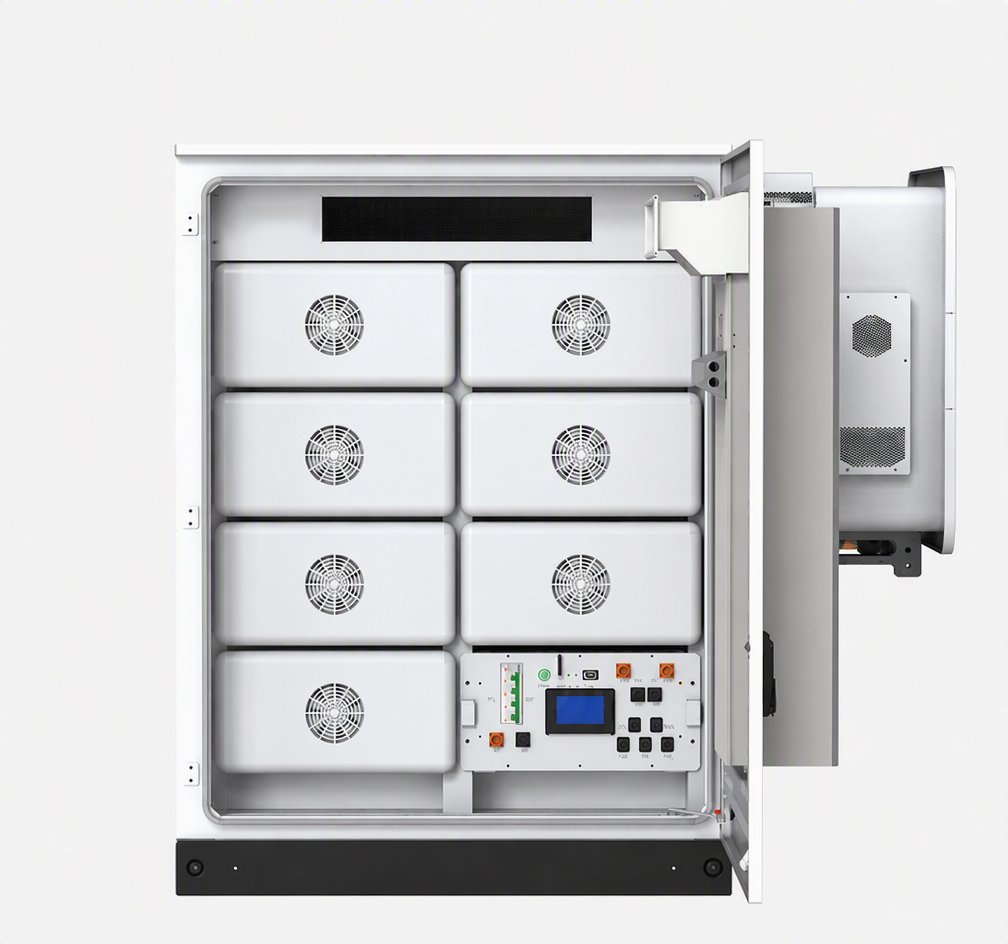
12. For inverters and batteries, which BMS, PCS, contactors and breakers do you use — and are those models on the certificate? A 100 kW inverter whose certificate lists a different IGBT module, or a battery cabinet whose certificate lists a different BMS, is not the product that was tested. Ask for the report’s component list and compare it with the physical unit.
Block 4 — Quality control (Q13–Q16)
13. What inspections run at IQC, IPQC and OQC, and at what AQL do you sample? Ask for last week’s filled records, not a blank template. The date, the inspector’s signature and the defect codes are what tell you whether the system runs on Monday morning or only before an audit.
14. Do you EL-test 100% of modules or sample them — and at which stage? Full EL after lamination is standard for export-grade lines; sampling is where micro-cracks survive. Ask to see the EL images for a specific batch and check that the file names match the serials on the pallet.
15. How long do you keep flash-test data, and will you send me the CSV for my order? The good answer is five to ten years, per-module, with the data shipped alongside the packing list. That file is your only defence if a module underperforms in year two and the supplier disputes the rating.
16. What were your scrap and rework rates for the last three months? A plant that reports 0% defects is either not measuring or not telling you. Ask for the numbers by process step — lamination, framing, junction-box soldering — and watch whether the answer is a figure or a speech.
Block 5 — Testing, certificates and documentation (Q17–Q18)
17. In whose name is the certificate, and can I verify the number on the issuing body’s website while we speak? The certificate holder must be the entity selling to you, or you need a licensing letter connecting the two. Verify the number yourself: IEC 61215 and IEC 61730 for modules, IEC 62109-1/-2 and UL 1741 for inverters, IEC 62619 and UL 9540A for battery cabinets. Screenshots from a supplier’s own brochure are not verification.
18. Which laboratory tested it, and can I see the full report rather than the certificate cover page? Reports carry a tested-model list. If your model number is not on that list, the certificate does not cover what you are buying — a gap that appears the moment a customs authority or a utility engineer reads the paperwork.
Block 6 — Commitment and delivery (Q19–Q20)
19. If I place two containers today, what is the committed ship date, and what penalty applies if you miss it? Ask for the on-time rate over the last six months, then put both the date and the penalty into the contract. A supplier who refuses a modest late-delivery penalty is telling you the date was aspirational.
20. If pre-shipment inspection fails, who pays for rework and who holds the deposit? The answer belongs in writing before the deposit leaves, together with the inspection standard you will use and the name of the inspector. This is the question that separates a supplier who has been through a failed inspection from one who has only read about it.
How to score the audit
Score every question 2, 1 or 0 and you finish with a number instead of an impression.
| Score | What it means |
|---|---|
| 2 | Document shown on the spot, and it is consistent with the other answers |
| 1 | Clear verbal answer, document promised later — chase it, then re-score |
| 0 | Evasive, refused, or contradicted by another document |
Out of 40 points: 34–40 proceed to a trial order. 26–33 proceed, but book a third-party pre-shipment inspection before every shipment. 18–25 treat them as a trader and price the risk accordingly. Below 18 walk away — there are enough suppliers in China that no one needs to gamble on this one.
Ten answers that should end the conversation
- “We can arrange a visit to our partner factory” — with no audit report to read, no accompanied visit on offer and no third-party inspector allowed in.
- A business license scan that arrives with the company name blurred or cropped.
- A certificate held by a third company, with no authorization letter.
- “100% EL tested” but no images for the batch you are buying.
- Serial numbers that cannot be traced without waiting a day.
- No written BOM change clause, or a refusal to name the cell supplier.
- A claimed 0% defect rate.
- A factory address that turns out to be an office floor in a business park.
- A request to pay the deposit into a personal account, or a third-party account with no contract link.
- “Lead time depends” with no schedule, no capacity figure and no on-time record.
Remote audit: a 60-minute protocol
If you cannot travel, a live video call covers about 70% of an onsite audit — provided it is live.
- Insist on a live walk-through. A recorded clip is a marketing asset, not evidence.
- Fix the route in advance: raw material store, cell store, line, EL station, aging area, packing, finished-goods warehouse.
- Ask the operator to hold the camera on the machine’s HMI showing the shift output counter, then on a pallet label with a date.
- Pick three serials from the warehouse on camera and ask for traceability while you are still on the call.
- Ask them to email the QC photos during the call, then check the file metadata timestamps.
Where EverRay fits — and how to audit us
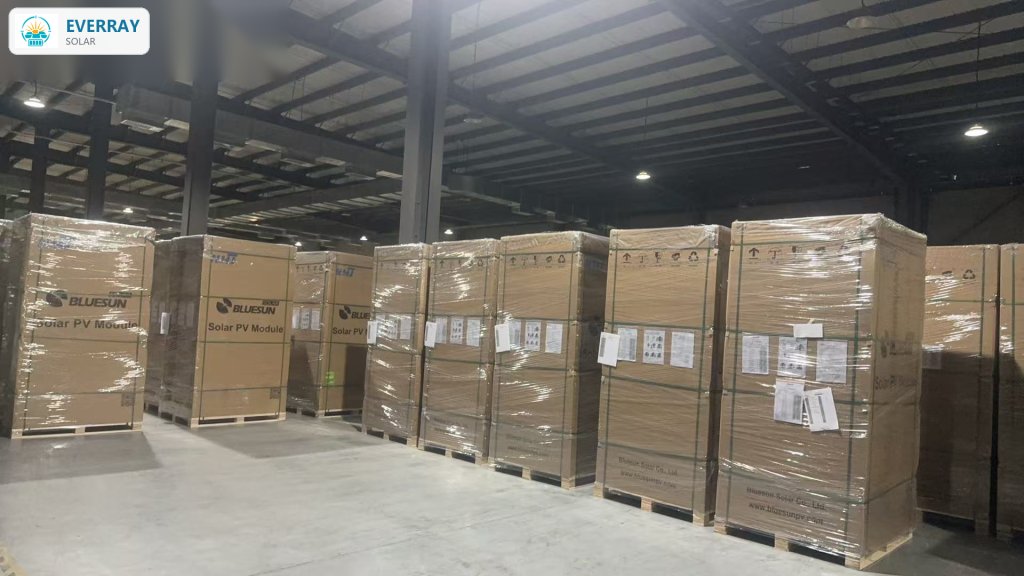
EverRay is a solar and storage brand. We engineer and specify every system, run pre-shipment quality control ourselves and consolidate the order; production runs across more than twenty audited partner plants in China, which is what lets us match a line to your power bin and delivery date under one brand and one warranty. The useful question for a buyer is therefore not “do you own a factory” but “which plant will make my order, and can I audit it”.
If you want to see what those lines actually ship, the product pages are the place to start: commercial and industrial energy storage systems from 30kW/64kWh starter units to containerized BESS, hybrid inverters from 2 to 150kW, and TOPCon dual glass modules from 440 to 730W. Every specification on those pages is the same figure you will be auditing against.
The answer is yes. We do not publish plant names — standard practice for a brand that adds engineering, quality control and warranty to the chain. Instead, we make a plant audit-ready without making it addressable:
- We commission the audit ourselves and share the full report — line photos, capacity figures, QC records, certificate numbers — with the plant’s identity replaced by a plant code.
- You can send SGS, BV, TÜV or your own inspector. We book the visit; the plant’s name goes to the auditor under a confidentiality undertaking, and the report comes to you anonymised if you prefer.
- You can join the visit yourself, accompanied by our engineer, under a mutual NDA, with no direct contact details exchanged on site.
- Every module, inverter and battery cabinet carries a serial that traces to a plant code, a production batch and a test record, so your warranty claim still attaches to a specific line and date.
If your own procurement policy requires the plant’s legal name before you place an order, say so at quotation stage. That is a commercial conversation we will have with a non-solicitation agreement in place — it is not something any exporter should publish on a website.
Start with the full supplier verification guide, see what a visit looks like on our factory tour, or check the certificates themselves on the certifications page.
Frequently asked questions
How long does a solar factory audit take? One day onsite is enough for the twenty questions above if you have the documents ready in advance, and two days if you want to watch a full shift including lamination and EL. A remote audit takes about an hour, plus a week for the documents to arrive and be checked.
Do I need a third-party audit from SGS, BV or TÜV? Worth it above roughly 300 kW of modules or a full container of storage, and essential when you are paying a deposit to a supplier you have not met. A focused factory audit typically costs a few hundred to a couple of thousand dollars depending on scope — cheap against a deposit you cannot recover.
Can a trading company pass this audit? Yes, if it is transparent. Plenty of good exporters do not own a line and never pretend to; they add engineering, consolidation, QC and documentation value. What fails the audit is not the business model — it is claiming a factory you cannot evidence: no audit report, no inspection access, no traceable batch record.
What should I check first if I only have one day? Business license and certificate holder, then which processes are in-house, then serial traceability. Those three answers tell you what kind of company you are dealing with; everything else is detail you can verify after the visit.
Then compare the shortlist side by side: our supplier assessment scorecard turns the twenty answers into a weighted ranking across six dimensions.
Send us your own audit checklist before you book anything and we will answer all twenty in writing, with the documents attached — including the ones where the answer is not flattering. Contact our team and you will have the pack within one working day.
Get a Quote for Your Solar Project
Tell us your destination market and requirement. We reply within 24 hours on business days with specifications, certificates and pricing — no obligation.
Get the 2026 EverRay Product Catalogue
25 pages · solar modules 440-735W, hybrid inverters 2-150kW, LiFePO4 batteries, home & C&I energy storage, solar pumps, lighting and PV cleaning