In most commercial buildings the electricity bill has two engines, and only one of them responds to solar. The kWh line falls when panels generate; the demand charge — billed on your highest 15- or 30-minute average demand of the month — does not move unless something actively caps that peak. In the Philippines a C&I customer pays roughly ₱660 per kW of billed demand per month (transmission plus distribution demand components in 2026 rate schedules), so a 180 kW site is carrying about ₱119,000 a month in demand charges before a single kWh is consumed.
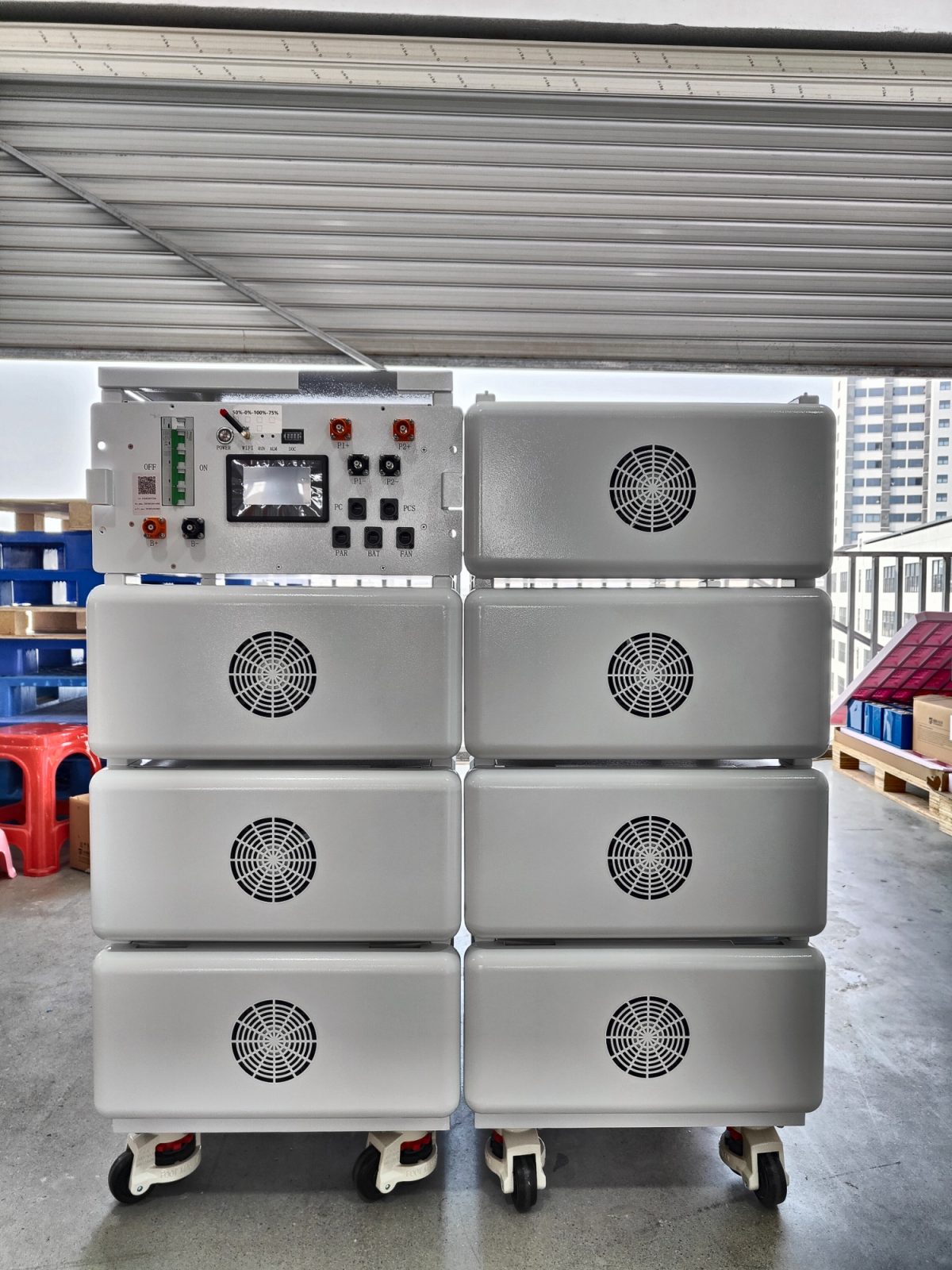
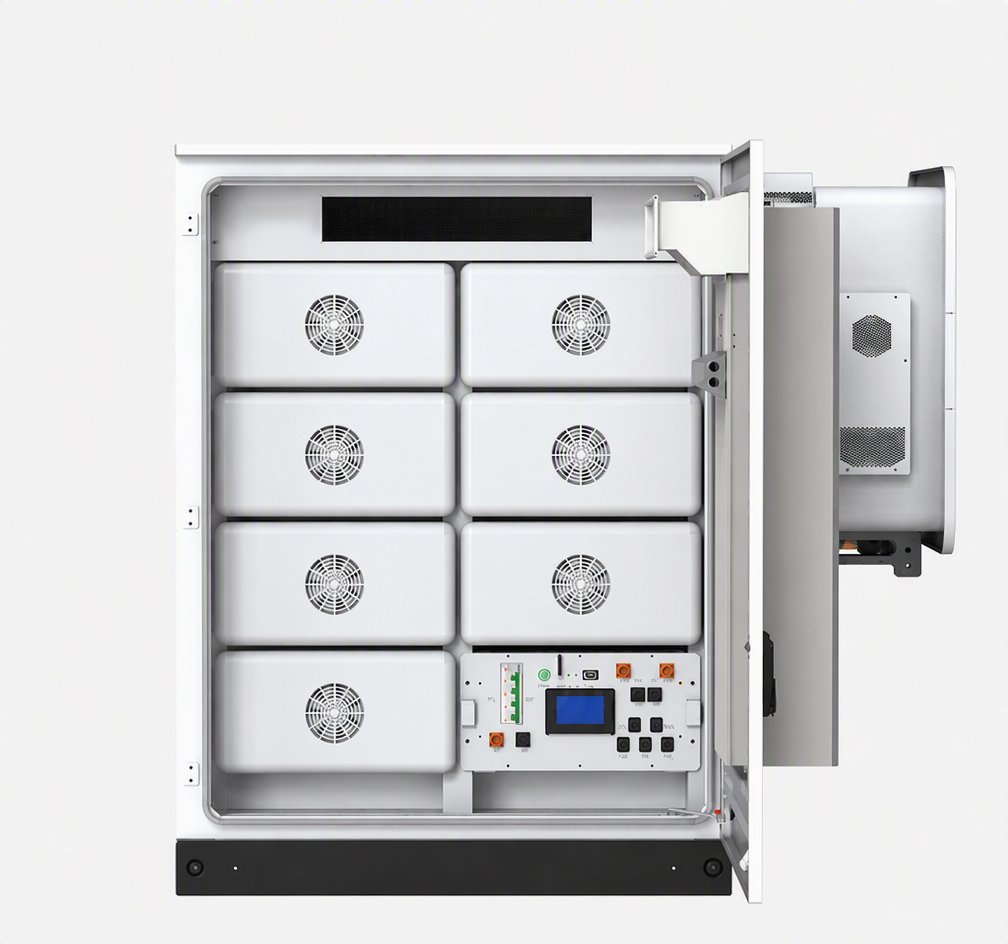
That line item is what battery storage attacks. This guide covers how demand charges are actually measured, why solar alone usually misses the peak, how a 30 kW / 64 kWh system shaves demand in practice, a worked example on a Philippine cold-storage bill, the sizing rules that matter, and the cases where peak shaving simply does not pay.
What a demand charge really is
Every utility meter records demand in intervals — 15 minutes in most of Europe, the Gulf and parts of Asia, 30 minutes in others — and the billing month is settled on the single highest interval, not the average. One bad afternoon sets the charge for the whole month. That is why a site can cut energy use by 10% and still see the same demand charge, and why a single simultaneous start of chillers, compressors or motors can raise the bill for 30 days.
Three details determine whether you can beat that number:
- The interval length. A 15-minute window means a 15-minute discharge is enough to hold the peak down; a 30-minute window requires the battery to sustain the reduction twice as long for the same result.
- The ratchet. Some tariffs bill on the highest demand of the last 11 or 12 months rather than the current month. Under a ratchet, savings only appear after the battery has held the cap through a full cycle of the year.
- Which demand is billed. Transmission and distribution demand can be charged separately, and a few tariffs also charge reactive power (kVAr). Confirm which components your meter reports before sizing anything.
Why solar alone does not shave the peak
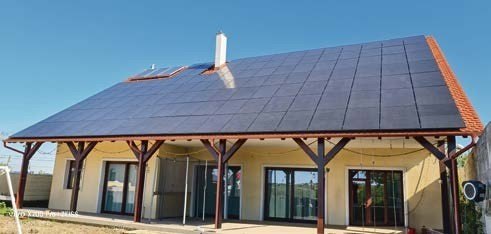
A PV array produces its maximum at midday. A cold store, a hotel or a factory usually peaks in the late afternoon or early evening, when the sun is low or gone and air-conditioning, lighting and shift loads overlap. The array has already done its work on the kWh line, but at the moment the meter records the month’s highest interval, PV output is close to zero.
Two consequences follow. First, adding panels to a site with an evening peak improves energy cost but leaves the demand charge almost untouched — a common source of disappointment when the payback model assumed both. Second, the battery becomes the only asset that can act at the right moment, which is why the pairing that works is not “solar plus storage” in general but solar for energy, storage for demand.
| Load pattern | Peak timing | Does PV cut the demand charge? |
|---|---|---|
| Cold storage, 24-hour base load | Afternoon, when compressors pull hardest | Partly — only if PV output coincides with the peak interval |
| Hotel or resort | 18:00–22:00, guests in rooms | Almost never |
| Factory, single day shift | Morning start-up, 07:00–09:00 | Rarely |
| Water treatment or pumping | Whatever the pump schedule dictates | Yes, if pumping is moved into daylight |
| Office building | Mid-afternoon, cooling load | Often yes — the closest match to the PV curve |
How a battery shaves the peak
Peak shaving is a control problem before it is a hardware problem. A current transformer at the point of common coupling reports the site load every second; when the load approaches a setpoint you choose — say 150 kW on a site that normally peaks at 180 kW — the inverter discharges to cover the difference. When the load drops back, the battery recharges, preferably from PV surplus or from cheap night tariff.
Four parameters define the result:
- Setpoint. The demand level the site is never allowed to exceed. Set it too low and the battery empties during a long peak; too high and you leave savings on the table.
- Power (kW). How much of the peak the inverter can cover instantaneously. A 30 kW unit can hold a 30 kW reduction, no more.
- Energy (kWh). How long that reduction can be sustained. 64 kWh of usable capacity supports roughly two hours of 30 kW discharge, minus conversion losses of 8–12%.
- Reserve. Capacity held back for backup or for a second peak later in the day, which reduces the shaving window but protects the site from outages.
The economics come from three stacked value streams: the demand charge reduction, the energy arbitrage from charging in low-tariff hours, and — where the grid is unreliable — the avoided diesel and downtime. Shaving alone rarely justifies the system; shaving plus arbitrage plus backup usually does.
Worked example: a Philippine cold-storage bill
The numbers below are illustrative and use published 2026 rate components for a Meralco industrial customer: energy at about ₱9.50/kWh, billed demand at about ₱660/kW for the combined transmission and distribution demand components. Your own bill will differ by rate class, power factor and pass-through charges, but the mechanics are the same.
| Line | Before storage | After a 30 kW / 64 kWh system |
|---|---|---|
| Monthly energy | 42,000 kWh | 42,000 kWh (1,664 kWh shifted to off-peak) |
| Peak demand | 180 kW | 150 kW |
| Demand charge | ₱118,800 | ₱99,000 |
| Energy charge | ₱399,000 | ₱395,700 (arbitrage on 1,664 kWh at ₱2/kWh spread) |
| Monthly total | ₱517,800 | ₱494,700 |
| Monthly saving | — | ₱23,100 ≈ USD 400 |
| Annual saving | — | ₱277,000 ≈ USD 4,800 |
Against a landed cost of roughly USD 11,000–14,000 for a 30 kW / 64 kWh cabinet, that is a 2.5 to 3 year payback on demand charges and arbitrage alone, before any backup value is counted. Two sensitivities matter more than the headline: if the site peak drifts up during the year the setpoint has to follow it, and if the tariff carries a ratchet the first months show less saving than the steady state.
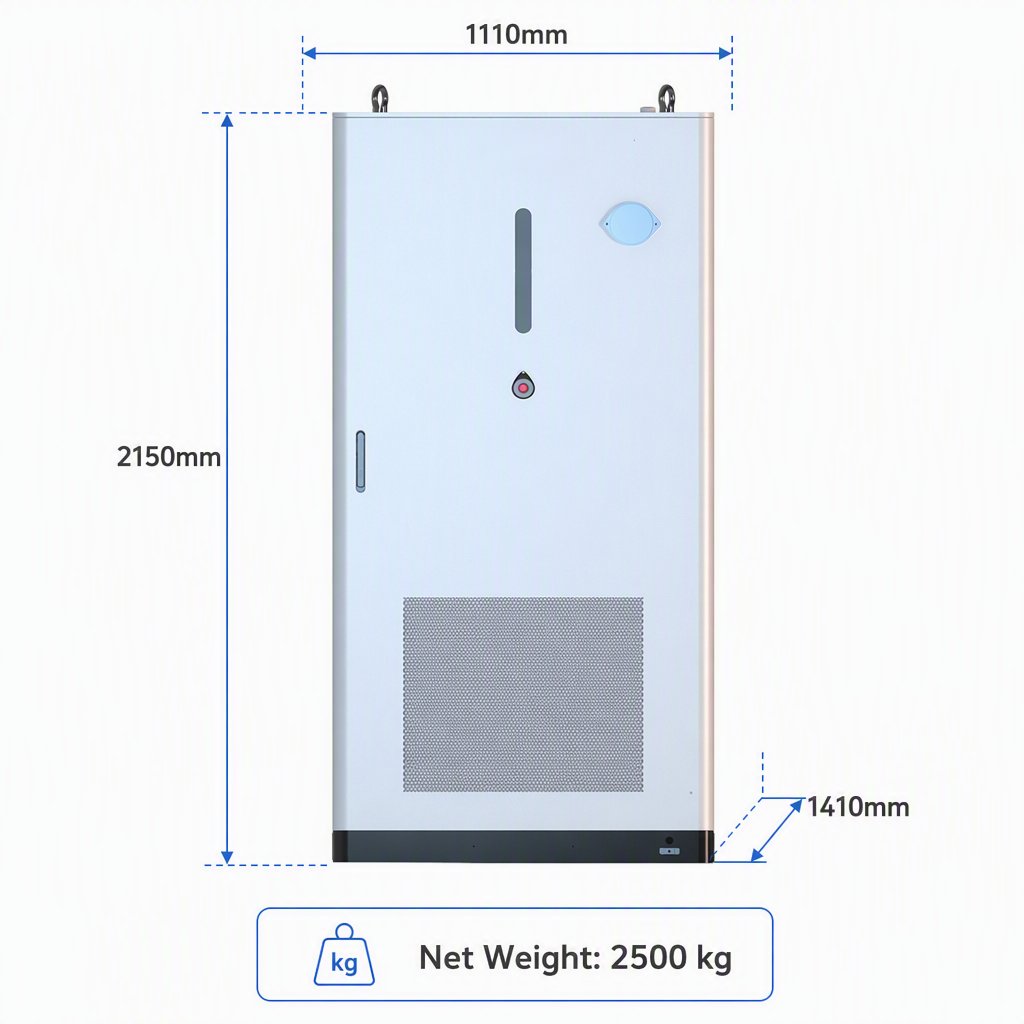
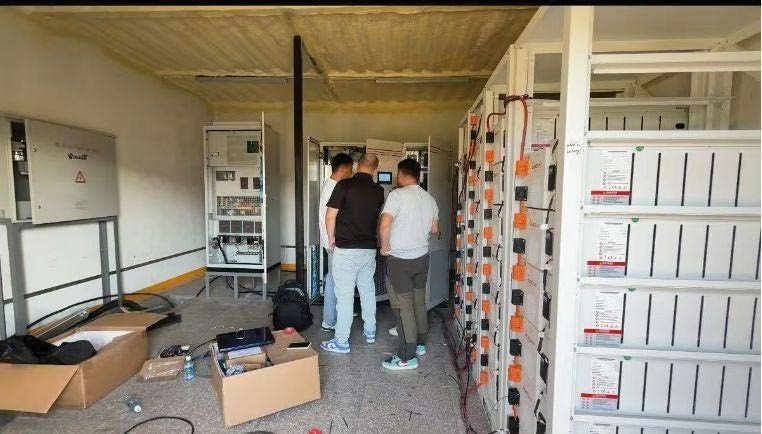
A 30 kW unit on a 180 kW site is a 17% reduction. That is the honest ratio for this class of equipment: a single cabinet is not designed to flatten a 500 kW load, it is designed to take the top off a small commercial or light industrial site, or to serve as one module in a parallel bank. Larger sites parallel several units on one control layer — the commercial and industrial battery storage range runs from 30 kW cabinets to 500 kW liquid-cooled containers for that reason.
Sizing rules that hold up
Three rules cover most of the ground before any modelling:
- Power equals the cut you want. Decide the target reduction in kW first. Everything else follows from it.
- Energy equals power times duration. Count the peak events per day and how long each lasts. Most commercial sites need 1–3 hours of shaving per day; 64 kWh paired with 30 kW covers two hours at full power.
- Charge capacity must exceed discharge. If the battery charges from PV, the array has to produce the shaved energy plus losses, or the battery will not be full when the peak arrives.
For a 30 kW inverter the practical sweet spot is a site peaking between 100 and 250 kW with a tariff that charges demand separately. Below 100 kW the savings are real but small in absolute terms; above 250 kW a single cabinet becomes a partial solution and the design moves to parallel units or a container.
Where peak shaving does not pay
It is worth saying plainly: this model fails in several common markets. Where electricity is cheap and mostly energy-based — Vietnam at around USD 0.08/kWh, for instance — there is little demand charge to attack and the arbitrage spread is thin. Where the tariff has no demand component at all, the entire value case collapses to backup, and backup alone rarely pays back on economics. And where the load is already flat — a continuous process plant running at the same level day and night — there is no peak to shave.
The test is simple and cheap: pull twelve months of interval data and the tariff sheet. If the highest interval is well above the average, and demand is billed separately, the site is a candidate. If those two conditions are missing, no amount of storage hardware will fix it.
What to ask before signing
Five questions separate a working design from a brochure:
- What interval does my meter use for demand, and does my tariff carry a ratchet?
- Which demand components are billed — transmission, distribution, both — and is reactive power charged?
- How is the setpoint controlled, and what happens when the load exceeds battery power for longer than the energy allows?
- What is the guaranteed round-trip efficiency and the warranted usable capacity after five years?
- Does the controller log every shaving event, so the saving can be verified against the bill month by month?
FAQ
How much peak demand can a 30 kW / 64 kWh system shave?
Up to 30 kW instantaneously, sustained for roughly two hours at full power after conversion losses. On a site peaking at 150–200 kW that is a 15–20% reduction in billed demand. Larger reductions require parallel units or a containerised system.
Does solar plus storage automatically cut demand charges?
No. The battery only cuts demand when the controller is programmed with a setpoint and the inverter is sized to hold it. Many hybrid systems are installed for self-consumption and never do peak shaving, which is why the demand line on the bill stays unchanged.
How long does the battery need to discharge to affect the bill?
Demand is an average over a 15- or 30-minute interval, so a discharge that covers the peak interval is enough for that event. Because peaks recur at different times and lengths, most designs plan for one to three hours of shaving a day rather than a single short burst.
What happens if the peak lasts longer than the battery can sustain?
The site draws the difference from the grid and the billed demand rises above the setpoint for that month. Good controllers anticipate this from historical load shape and reserve capacity; a conservative setpoint is cheaper than an undersized battery.
Can one system do peak shaving and backup at the same time?
Yes, with a reserve state of charge held back for outages. The trade-off is direct: every kWh reserved for backup is a kWh unavailable for shaving, so the usable shaving capacity is lower than the nameplate figure.
What data do I need to size a peak-shaving system?
Twelve months of 15-minute interval data, the tariff sheet with all demand components, and the site’s single-line diagram. Twelve months matters because the billing peak is set by the worst month, not the average one.
Get a demand-charge analysis for your site
Send a recent electricity bill and twelve months of interval data if you have them, together with the site type and country, and you will get a sizing proposal that states the kW reduction, the kWh required, the expected monthly saving on your own tariff, and the payback. Systems from 30 kW / 64 kWh to 500 kW containers, delivery in one to two weeks, MOQ one set. Related reading: 30 kW hybrid inverter specifications and 50 kW three-phase hybrid inverter.
Get a Quote for Your Solar Project
Tell us your destination market and requirement. We reply within 24 hours on business days with specifications, certificates and pricing — no obligation.
Get the 2026 EverRay Product Catalogue
25 pages · solar modules 440-735W, hybrid inverters 2-150kW, LiFePO4 batteries, home & C&I energy storage, solar pumps, lighting and PV cleaning